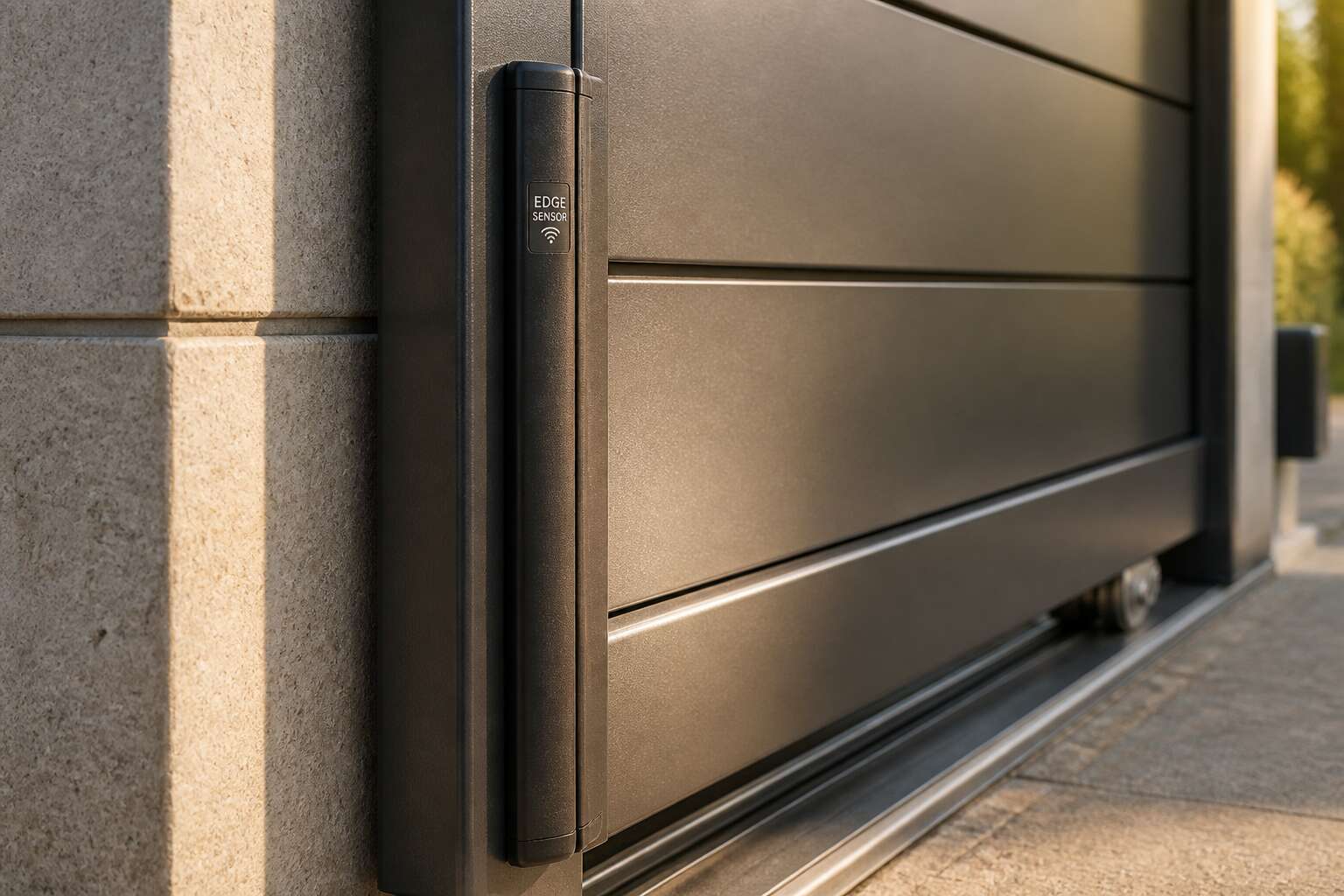
Understanding Perimeter Safety for Automated Entrances
Common Hazards in Automated Entry Systems
Every year, automated entrance systems across South Africa account for thousands of near misses. The danger is often silent. A gate reverses too slowly, a sensor fails, or a child wanders into the path of a moving leaf. Understanding perimeter safety starts with acknowledging that these machines operate in unpredictable spaces.
Common hazards in automated entry systems include:
- Pinch points where fingers or clothing can be caught
- Vehicle blind spots that obscure pedestrians
- Inconsistent sensor response during high winds or dust
- Worn mechanical parts that cause erratic movement
A sliding gate edge sensor serves as the final line of defence. It detects obstruction along the gate’s leading edge and halts motion before contact becomes impact. Many property owners underestimate how quickly a sensor must respond. A quality sliding gate edge sensor reacts in milliseconds, reducing the force of impact significantly. In rural and urban properties alike, this small device transforms a heavy steel structure into a safer everyday tool.
The Role of Pressure-Sensitive Components
Perimeter safety is not a static condition. It shifts with every gust of wind, every loose stone, and every person who steps too close. In South Africa, the boundary between safe and unsafe is measured in centimeters. A pressure-sensitive component at the gate’s leading edge interprets contact instantly, converting physical force into a command to reverse.
The sliding gate edge sensor operates at that boundary. Unlike optical systems, which can be fooled by glare or dust, a pressure-sensitive element relies on direct touch. That reliability depends on surviving harsh conditions:
- Rapid temperature swings
- Continuous flexing
- Dust and moisture exposure
Each of these conditions tests the sliding gate edge sensor daily. When it responds in milliseconds, the gate stops before a collision turns into an injury. That is the essence of perimeter safety!
Real-World Scenarios Where Protection Matters
Perimeter safety depends on how close a person can come to moving steel before the system reacts. At an automated entrance, that gap is often less than the length of a shoe. The sliding gate edge sensor sits at that exact point.
Here is a common scene. A courier sets a parcel down inside the driveway while the gate is closing. His foot crosses the threshold. The sensor detects contact and stops the drive before any force transfers to his ankle.
Other situations demand the same speed. A sliding gate edge sensor has to deal with:
Worn rollers shifting the gate’s alignment
Rust building on the bottom rail
Debris blown against the leading edge
Each instance changes the geometry of the gate, yet the sensor still has to interpret contact correctly. Perimeter safety only exists when that interpretation happens instantly.
Why Regular Testing Is Non-Negotiable
Perimeter safety for an automated entrance rests on a single promise. The sliding gate edge sensor must respond the same way on a dusty Highveld afternoon as it does on a rain-soaked evening. That consistency does not happen by accident. It happens because someone tests the system, again and again, knowing that a missed check may surface later in the worst possible moment.
Regular testing reveals the quiet failures before they become loud ones. Consider what a test must account for:
- The speed at which the gate travels after months of motor wear
- The tension of the seal that protects the sensor from moisture
- The condition of the wiring where it flexes at the hinge point
Each variable changes the sensor’s reaction time. The sliding gate edge sensor is only as reliable as the routine behind it. That is the reality of perimeter safety. It is not a one-time installation. It is a continuous relationship between the machine and the person who maintains it.
Key Mechanisms Behind Contact Detection
How Pneumatic Ribbon Switches Operate
A pneumatic ribbon switch operates on a simple principle: air under pressure. The sliding gate edge sensor’s rubber tube contains a column of air. When the gate encounters an obstruction, the tube deforms and compresses that air. The pressure wave travels to a switching mechanism, which triggers the gate to reverse.
- Contact with an object compresses the tube.
- The displaced air activates a diaphragm or piston.
- The diaphragm closes an electrical circuit.
Because the system contains no electronic components along the edge itself, it remains immune to water ingress and vibration. The entire mechanism relies on physical displacement. That simplicity means fewer parts to fail. This design provides consistent response even after years of heavy use.
Using Opto-Electrical Sensing for Precision
One millimetre of deflection. That is all an opto electrical sliding gate edge sensor needs to trigger a stop. Unlike pneumatic systems, it does not rely on air pressure. Instead, a light source and a photodetector sit inside a flexible casing. When the edge deforms, the light path changes. The detector registers the interruption and sends a signal instantly.
This method offers distinct advantages:
- Sub millimetre sensitivity to impact
- No moving parts to wear out
- Direct signal transmission without pressure lag
The precision makes it ideal for high traffic sites where gates operate constantly. For a sliding gate edge sensor, this means fewer false stops and faster operation. We see this technology across South African industrial properties, and the response is instant!
Comparing Flexible and Rigid Mounting Options
Contact detection begins with the mounting. Flexible mounting, typically a polymer bracket, lets the sliding gate edge sensor deflect before triggering. This reduces nuisance alarms from wind and debris. Rigid mounting transfers force directly to the sensor element. The response is immediate, but shock loads can wear components faster.
Consider the practical trade-offs:
- Flexible mounts suit uneven driveways where bushes or stones brush the gate.
- Rigid mounts suit clean industrial yards with controlled traffic.
The threshold of what counts as contact shifts with each option. For heavy sliding gates, I prefer flexible mounts because they absorb the initial bump. The sensor then registers only genuine obstructions.
Signal Transmission and Control Panel Integration
A sliding gate edge sensor only earns its keep when the signal it generates survives the journey to the control panel. The contact mechanism, whether a ribbon switch or an optical element, produces a simple electrical state change. That change must be converted into a clean, unambiguous pulse. Weak signals, often caused by voltage drop over long cable runs, create intermittent failures. The panel never sees the obstruction. This is the quiet failure mode that haunts lazy installations.
Control panel integration is where the sensor’s raw data becomes a safety decision. The panel must interpret the signal within milliseconds and command the motor to stop or reverse. For South African sites, where power surges from load shedding are common, the panel’s logic must filter out electrical noise. False triggers on a perimeter gate erode trust. The signal chain is only as strong as its weakest connection.
– Verify the sensor’s output type matches the panel’s input (normally closed is standard).
– Check the cable gauge for runs longer than 20 metres.
– Confirm the panel’s debounce time tolerates the sensor’s activation delay.
A sensor feeding a poorly configured panel is a liability. On rural estates, I have seen gates reverse for no reason because the panel ignored the sensor’s momentary signal. The result is a gate that never closes, or worse, one that closes on a vehicle because the signal was filtered out. The integration must be intentional. For solar gate motors, the power budget affects signal strength, so the sensor’s draw matters. The sliding gate edge sensor is not a standalone device; it is a voice in a conversation with the controller. If the controller does not listen correctly, the protection is fiction.
Distinguishing Between Object and Person Contact
Automated gates do not possess the cognitive ability to judge intent. They respond to force, displacement, and speed. The critical differentiator in a sliding gate edge sensor is the rate of change in pressure. A person, especially a child, contacts the gate slowly, with hesitation. A vehicle, even a bakkie reversing at idle, transfers energy with abrupt finality. The sensor’s internal mechanism must read that delta.
Consider the physical reality. A rubber buffer compresses over milliseconds during vehicle impact. A human limb pushes the same buffer over a full second. The sensor distinguishes these temporal signatures. This is not about sensitivity; it is about discrimination.
– A person’s contact produces a gradual resistance curve.
– A vehicle’s contact creates a sudden, steep pressure spike.
The sensor logic prioritizes the spike. I have stood at installations where the gate brushed a passerby and stopped cleanly, yet shrugged off a delivery van’s bumper. The mechanism interprets mass through acceleration. It reads the story of the collision. This distinction is the entire moral weight of the device. Without it, the gate either becomes a nuisance that stops for every leaf, or a murderer that ignores a human body entirely.
Choosing the Right Protection for Your Property
Assessing Gate Weight and Travel Speed
A gate that weighs two tonnes and accelerates quickly demands a far more sensitive control mechanism than a lightweight aluminium barrier! Assessing gate weight and travel speed is the first step in choosing the right protection for your property. The kinetic energy stored in a moving gate defines the force delivered upon contact.
- The total mass of the gate, including any decorative cladding.
- The maximum travel speed, usually measured in metres per second.
- The stopping distance available after the sensor activates.
For a heavy South African gate moving at high speed, a sliding gate edge sensor must trigger within milliseconds, while a slower, lighter gate permits a more lenient threshold. Matching these values ensures reliable detection.
Environmental Factors: Dust, Rain, and Temperature Extremes
South Africa’s climate punishes electronic components without mercy. A sliding gate edge sensor that operates reliably in Johannesburg’s dry Highveld air can fail within months along the KwaZulu-Natal coast, where salt-laden mist corrodes exposed terminals. Dust acts as the silent offender. Fine particles settle onto the contact surface and gradually dull the sensitivity that once protected your property perimeter.
Temperatures compound the problem. Daytime heat causes expansion in the rubber housings that shield the sensing element, while night-time cooling opens microscopic gaps. Moisture enters through these tiny passages during summer thunderstorms, and the damage accumulates invisibly.
- Windblown dust clogging the flexible edge actuator
- Coastal humidity corroding internal wiring connections
- Thermal stress cracking in direct Free State sunlight
Selecting the right protection demands verifying that your sliding gate edge sensor carries an ingress protection rating matched to your specific valley, coast, or Karoo exposure rather than a generic national average.
Wireless Versus Wired Connectivity Solutions
In my experience, every property manager eventually faces the same question: should the sliding gate edge sensor connect by wire or over a wireless link? The answer depends on your existing infrastructure and maintenance appetite. Wired systems offer direct power and continuous signal integrity. Wireless setups reduce cable theft risk, a genuine concern in many South African installations.
Consider what you already have:
- A concrete driveway with buried conduit favors wired installation
- A rental property with frequent tenant changes benefits from wireless portability
- A remote gate without nearby power needs battery operated wireless
The sliding gate edge sensor must match your operational reality, not the sales brochure. A wireless unit saves installation time but introduces battery monitoring duties. Wired connections demand professional fitting but deliver predictable performance. Assess the tradeoffs honestly before committing.
Compatibility with Existing Control Systems
Choosing the right protection often comes down to what is already bolted to your driveway. Many South African properties run older gate motors with control boards that lack standardised inputs. The sliding gate edge sensor must speak the same electrical language as that board. A simple contact closure works with most units, but some panels demand a supervised loop with an end-of-line resistor. Ignoring this detail produces intermittent faults that frustrate tenants and guards alike.
Check the motor’s response configuration before you buy. Some boards reverse the gate on trigger. Others shut down entirely. That behaviour defines how your sliding gate edge sensor protects people and vehicles. You want a predictable reaction in both directions.
Signal compatibility matters, too. A pneumatic ribbon switch connects directly to a dry input. Opto-electrical units may need a powered interface. The control panel determines which sensing technology will function. For electric gate specialists, the verification steps include:
– Confirm the input type on the motor controller
– Match the sensor’s contact rating to the circuit
– Test the full cycle, open and close, after installation
Build Quality and Ingress Protection Ratings
Build quality and ingress protection ratings determine whether your sliding gate edge sensor survives its first Johannesburg thunderstorm or a coastal summer. A unit with an IP65 rating shrugs off dust and rain. An IP67 can handle temporary submersion. The difference matters more than the sticker price.
The rubber extrusion and internal switch contacts deserve scrutiny. Cheap housings crack under UV exposure and leave the sensor dead at the worst moment. Reinforced polyurethane or powder-coated aluminium handle years of direct sun without becoming brittle.
- The seal where the sensing element meets the mounting channel
- The quality of the end cap screws
- Whether the cable gland provides a true compression fit
For most residential estates, an IP54 rating is the minimum you should accept. For farms or coastal properties, push toward IP66 or higher. The salt air and fine dust will find every unsealed seam.
Cost-Benefit Analysis of Different Sensor Types
Your property’s exposure profile determines how much you should invest in a sliding gate edge sensor. In Johannesburg, UV and heat degrade cheap housings; along the coast, salt air corrodes unsealed contacts. I have seen a R500 sensor fail within months, while a rugged unit lasts a decade!
The cost-benefit analysis comes down to three options:
- Pneumatic ribbon: lowest upfront cost, but compression wear and calibration drift.
- Opto-electrical: premium price, yet no moving parts and consistent precision.
- Rigid extrusion: durable mounting, but higher installation effort.
Match the type to the gate’s duty cycle and the property’s threat level. A farm with livestock needs a robust system; a residential estate can use a mid-range model. The price of a sliding gate edge sensor is minor compared to a liability claim. Evaluate total ownership costs rather than the initial price.
Installation and Maintenance Best Practices
Positioning and Alignment for Optimal Response
A misaligned sliding gate edge sensor is more dangerous than no sensor at all, and I’ve seen the consequences on site. Installation demands precise positioning along the gate’s leading edge, where contact occurs first. The detection zone must sit flush with the surface profile, accounting for the gate’s travel arc and uneven ground. Thermal expansion and constant vibration loosen mounting hardware, so alignment checks should happen more often than owners expect.
Optimal response depends on keeping the sensor parallel to the opposing surface. Even a few millimetres of deviation delays activation, turning a safety system into a cosmetic feature. Consider these alignment critical points:
- The sensor tip must extend beyond the gate face
- Brackets need shims for fine adjustment
- Cable routing must avoid pinch points near hinges
Periodic re-alignment preserves the sliding gate edge sensor’s reliability under South African conditions. Dust and grit accumulate on the sensing surface, dampening response, so routine cleaning complements the physical adjustments.
Wiring and Power Supply Considerations
Wiring and power supply considerations determine whether a sliding gate edge sensor performs when it matters. Voltage drop is a silent killer on long cable runs common on South African estates. I have replaced sensors that failed solely due to inadequate power delivery. A sensor receiving nine volts instead of its rated twelve may still trigger, but response becomes sluggish and unreliable.
Cable choice carries weight. Flexible, UV-resistant conduit suits the constant motion of the gate frame. Rigid conduit fractures under vibration. Waterproof junction boxes are essential; exposed terminals corrode within months.
- Long cable runs suffer voltage drop that weakens sensor response
- Stranded conductors withstand the constant flexing of gate movement
- A single earth point on the cable shield prevents ground loops
Power supply quality affects every downstream component. A dedicated circuit avoids electrical noise from the gate motor. Surge protection matters in regions prone to lightning storms.
Routine Cleaning and Wear Inspection
The sliding gate edge sensor tolerates a great deal, but absolute neglect will eventually test its patience. A routine inspection schedule costs an hour per month, which is far cheaper than replacing a bent gate chassis or managing a liability claim. Dust and grit accumulate inside the sensor channel, particularly in windy Highveld regions, and this debris hardens the rubber or dampens the pneumatic ribbon switch response over time. Clean the channel with a soft brush and a mild soap solution, never a high-pressure hose, because water ingress through the sensor seam will cause more problems than the dirt ever did.
Wear inspection means looking for physical damage beyond the surface level. Cracks form at the base of the mounting brackets first, often invisible until you flex the sensor slightly.
– Check for compression marks on the sensing area that indicate repeated impact
– Look for chafing where the cable exits the channel and rubs against the gate frame
– Examine the end caps for separation, which exposes the internal connection terminals
A sensor that passes all these checks still needs fasteners reviewed. The constant vibration of the gate motor loosens bolts over time, and a sensor that shifts just a few millimetres loses its alignment with the closing edge. That misalignment converts a safety device into a decorative strip. Regular cleaning and timely replacement of worn parts prevent this. Focus on the small maintenance tasks and the sliding gate edge sensor remains functional and dependable, not a paperweight waiting for an emergency.
Troubleshooting False Triggers and Failures
Installation begins with precise channel alignment and torque specification. A sliding gate edge sensor mounted too tightly against the frame will register phantom contact, while a loose fit leaves dangerous gaps. Use a calibrated torque wrench and rubber-compatible sealant at every bracket point, then cycle the gate manually to verify the sensor edge meets the post squarely.
False triggers often originate from electrical noise or poor earthing. Check the control panel for voltage spikes from the motor starter. A digital multimeter reveals resistance fluctuations in the ribbon switch, which indicate internal wear rather than external impact.
- Isolate the sensor from the gate controller.
- Measure continuity across the terminal strip.
- Replace the connection cable if readings oscillate.
Water ingress remains the leading cause of intermittent faults. Inspect the gland nut and apply dielectric grease after each rainy Highveld storm, especially where the conduit enters the housing.
Compliance and Industry Regulations
Safety Standards for Automated Entrances
A compliance audit is not a paperwork exercise. In South Africa, the Occupational Health and Safety Act and SANS standards place obligations directly on the party controlling an automated entrance. A single component often determines the outcome of that audit. If the gate’s sensing edge does not react within declared limits, the installation becomes legally exposed.
Verification during an audit typically covers:
- Entrapment risk zones identified in the initial risk assessment
- Response times recorded against the manufacturer’s published specifications
- Proof that conformity documentation remains available on site
I have seen too many sites where the steelwork was robust but the sensing arrangement was an afterthought. That is where the exposure sits. The proper mounting of a sliding gate edge sensor can change the outcome of that audit.
Manufacturer Guidelines and Certification
South African regulations place the burden of proof on the gate owner, and a sliding gate edge sensor without certification is a weak defence. I have reviewed audit files where the sensor performed correctly in testing, yet the installation failed because the certificate named a different model. The SANS framework demands a direct match between installed hardware and documented evidence.
Manufacturer guidelines carry legal weight. They define the maximum gap between the sensor and the gate frame, the required overlap on the leading edge, and the electrical characteristics the control panel must supply. Deviation from these figures voids the certification and shifts liability to the installer.
- Certificates must identify the exact sensor model
- Test reports must reflect the installed orientation
- Documents must align with the site’s risk assessment
An uncertified sliding gate edge sensor may operate flawlessly for years, but an incident will be judged on documentation, not performance.
Liability Implications for Property Owners
Sliding gate incidents are rarely adjudicated on what actually happened; they are adjudicated on what can be proven. The Property Practitioners Act and the Occupational Health and Safety Act do not care about a sensor’s flawless decade of service. They care about the paper trail. If a sliding gate edge sensor is installed without the correct certificates, the owner becomes the singular point of failure in the legal chain. The liability is not shared with the installer or the manufacturer; it is assumed entirely by the person who controls the premises. This position is uncomfortable, but it is also the law.
The audit process is where most owners stumble. A valid certificate is merely the entry ticket. The entire installation must match the documentation:
– The sensor model on the certificate must match the unit on the gate.
– The orientation of the sensor in the test report must reflect the physical mounting.
– The risk assessment must reference the specific site and its identified hazards.
South African courts have shown no patience for the “it worked yesterday” defence. An operator who cannot produce a certified record for a sliding gate edge sensor is considered negligent, regardless of the device’s actual performance. This harsh reality is the difference between a lawful installation and a decorative one. The documentation is not bureaucracy; it is the only barrier between the owner and a negligence ruling.
Periodic Certification and Documentation
In South Africa, a certificate is not a memory; it is a living record. Periodic certification forces a sliding gate edge sensor to prove itself again, under current site conditions. The documentation must reflect each inspection, every calibration adjustment, and the precise date of the test.
A valid audit trail requires more than a stamp. For each sliding gate edge sensor, the records should show:
- The sensor’s serial number and firmware version at the time of testing.
- The measured response time under load and the ambient temperature.
- The name and registration number of the certifying technician.
Without these specifics, the file loses its meaning. Regulators expect the paperwork to match the physical installation at every step, not merely at commissioning. I have seen owners with flawless sensors fail solely because their certification cycle lapsed. The device still worked, but the proof did not exist. That gap is the difference between compliance and a decorative installation.




0 Comments