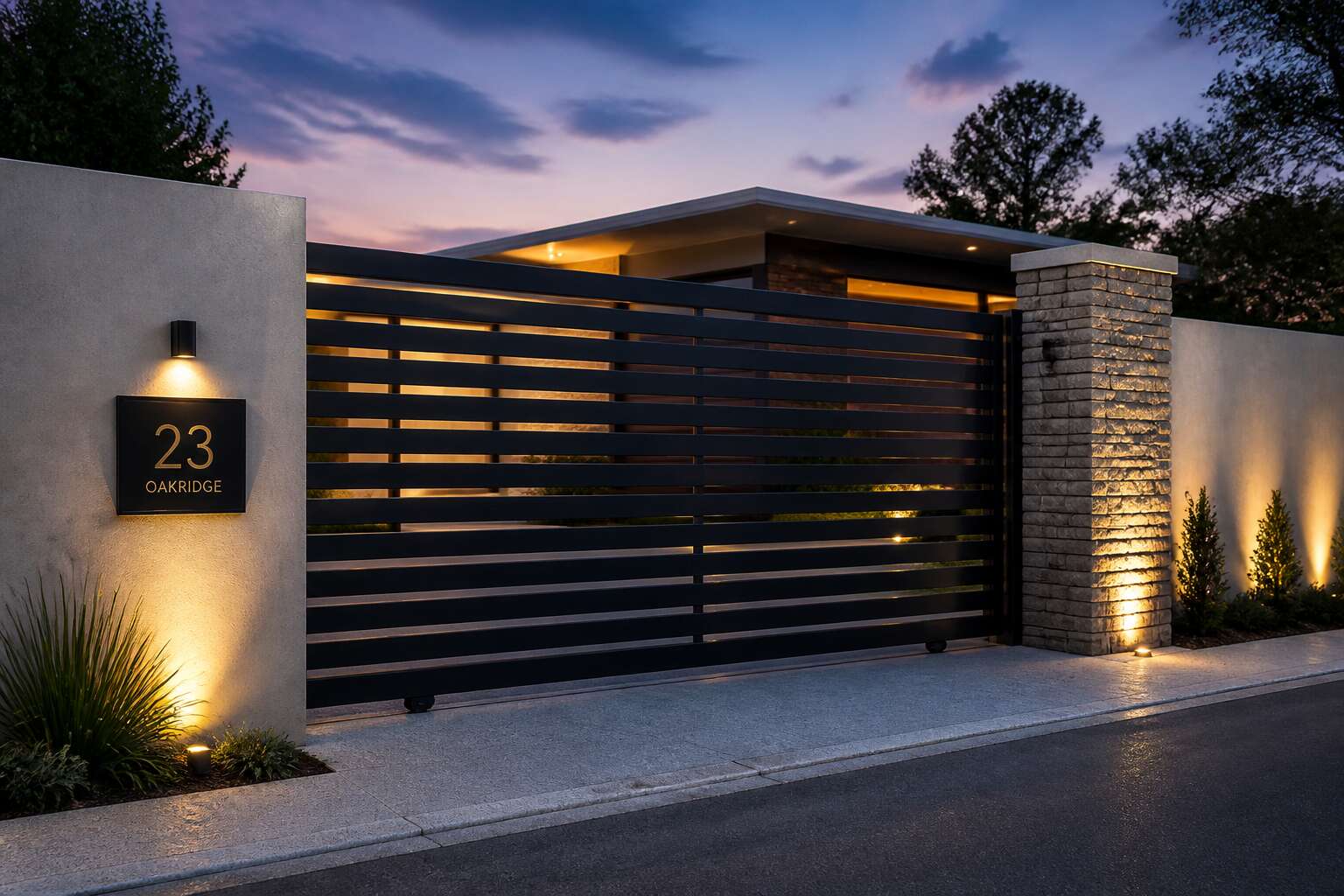
Sliding Gate System Variations
Track-Based Sliding Gates
Somewhere on your property, there is a strip of steel that will eventually collect stones, leaves, and at least one stubborn snail. That is the ground rail of a track-based sliding gate. These systems use a track mounted at driveway level, with rollers underneath the gate carrying the full load.
What makes track-based systems practical:
- The gate leaf needs a simple frame without heavy counterweights
- Installation is straightforward on existing driveways
- The drive mechanism faces fewer stress points than cantilever setups
The rail does need to stay clear of debris, which sounds simple until you experience a Highveld storm. Yet for many suburban properties, this remains one of the more cost effective driveway sliding gates designs. Track-based variations work best when the ground is level and the driveway is long enough to host the full travel distance.
Cantilever Sliding Gates
Cantilever sliding gates take a different approach entirely. There is no ground rail to maintain. The gate leaf hangs from a concrete foundation and steel posts, supported by rollers on a dedicated beam. The cantilever principle means the gate extends beyond the opening, using a counterweight to balance the load.
This design suits properties where the driveway slopes or shifts with seasons. When the earth moves, a track system bends or jams. A cantilever gate remains fully operational.
Here’s what makes these systems distinct:
- The gate never touches the driveway surface
- No debris collection points at ground level
- Rollers sit above ground, easier to service
The trade-off is weight. Cantilever gates require a heavier leaf and a substantial foundation. That cost appears in the driveway sliding gates designs for irregular terrain. For sites where drainage or roots make a level track impossible, these are the reliable option.
Telescopic Sliding Gates
Some properties offer no room for a single gate leaf to retreat into the property. This is where telescopic sliding gates answer. Instead of one massive panel, the gate comprises two or more sections that collapse into each other as one. The result is a gate that requires only a fraction of the usual opening space, making it a practical option within driveway sliding gates designs.
The sections run on a bottom track or suspend from overhead rollers, depending on the site. For long driveways with a narrow entry point, this variation balances function with a restrained elegance. The mechanical complexity exceeds that of a single-leaf system, but the space savings often justify the trade.
Single vs. Double Sliding Gate Configurations
The space on one side of your driveway determines the best sliding gate configuration. A single sliding gate moves as one leaf, needing a stacking area equal to its width. If that space is missing, a double sliding gate splits the load. Two leaves retreat to opposite sides, halving the required clearance. These choices shape driveway sliding gates designs across South Africa.
Double systems suit narrow entries where both boundaries offer a little room. They also balance mechanical strain across two panels. Single systems run simply along a track or cantilever, with lower cost and easier installation.
- Single configuration needs full side space and fewer moving parts.
- Double configuration works in tight widths and offers balanced operation.
The final decision rests on your property layout, not aesthetics. Both perform reliably when sized correctly, making them standard driveway sliding gates designs.
Materials and Durability Considerations
Powder-Coated Steel
South Africa’s coastal air carries salt that can corrode a standard steel gate within two years. Powder-coated steel resists this corrosion through an electrostatic process that bonds polymer to metal, forming a barrier far tougher than conventional paint.
When evaluating driveway sliding gates designs for Cape Town or Durban, powder coating thickness matters. Quality finishes measure at least 60 microns, preventing moisture from reaching the steel substrate. The curing process, where the coated panel bakes at high temperatures, creates a seamless protective layer.
Common markers of well-executed powder coating include:
– Uniform coverage along edges and corners
– Resistance to chipping from daily use
– UV-stable pigments that resist fading under intense African sunlight
Gates near the ocean gain further protection from a zinc-rich primer beneath the powder layer. This two-stage approach extends the service life of driveway sliding gates designs substantially.
Aluminum for Corrosion Resistance
Aluminum owes its coastal reputation to a quiet chemical trick. When the metal meets air, it forms a thin oxide layer that seals itself against further attack. Scratches merely expose fresh aluminum, and the layer heals on its own. That trait alone elevates certain driveway sliding gates designs above their painted rivals.
I have seen steel gates fail within two winters near the sea, yet aluminum gates remain composed. The material is also lighter, which eases strain on sliding mechanisms. Not every extrusion offers the same protection, though. Consider these points when evaluating an aluminum gate:
- Alloy grade, preferably 6063 or similar marine-grade composition
- Wall thickness, since thin profiles flex and fatigue
- Finish, either anodized or a quality powder coat
For South African homeowners, aluminum removes the worry of hidden rust forming beneath a scratched surface. That peace of mind matters when the salt breeze arrives.
Wrought Iron Classic Appeal
There is a particular gravity to a wrought iron gate, a sense of permanence that lighter materials do not possess. For many South African homeowners, it remains the benchmark for driveway sliding gates designs. Each bar and scroll speaks to a tradition of strength, offering a security presence that feels both formidable and refined.
The material’s character develops through its asking price: maintenance. A quality blacksmith will use genuine iron, not mild steel, and that distinction matters for longevity. The process of forge welding creates a denser structure, resistant to the fatigue that plagues lesser metals. However, let’s be clear about the weight involved. Your sliding mechanism must be engineered for this massive load, or you will face constant alignment issues.
– The chosen profile must be thick enough to resist bending under forced entry attempts.
– Protective coatings, like a hot-dip galvanized undercoat, are non negotiable in our climate.
– Cast collars and finials add that heritage aesthetic but should be secured mechanically, not just welded.
Without this scrutiny, you buy a costly ornament. With it, you own a piece of engineering that can outlive the house itself. The movement of a well balanced iron gate is a slow, deliberate event, a ritual that adds a layer of ceremony to arriving home.
Untreated Timber and Engineering Wood
Untreated timber carries a real risk. In South Africa’s sun and storms, it dries, cracks, and invites termites. A gate built from it may look honest, but within three seasons, it starts to deform. That is why driveway sliding gates designs often move toward engineering wood.
Engineering wood, such as laminated beams or high-density plywood, resists moisture and swell. The layers are glued under pressure, creating a stiffness that untreated planks cannot mimic. For a sliding gate, this rigidity matters because the load shifts along the track.
- Check the glue type. Waterproof phenolic resins hold better in humidity.
- Inspect the edge sealing. Unsealed ends let moisture creep inside.
- Demand a UV-resistant topcoat, or the surface will silver and split.
I have seen untreated timber fail with cracked joints. Choose engineering wood, and you buy predictability!
Glass Panels and Modern Composites
Glass panels change how a gate reads from the street. Instead of hiding the property, they offer a curated glimpse. For driveway sliding gates designs, this matters in suburbs where visibility is part of security. Use laminated glass, not tempered. Laminated holds together when shattered, and in a sliding gate that vibration matters.
Modern composites are the quieter option. They are a pressed blend of polymers and fibre, neither wood nor metal. They handle South African UV without fading.
- Check the aluminium frame thickness around the glass.
- Look for gaskets that stop water ingress at the panel base.
Composites resist termites and rust completely. They flex slightly under load, which eases stress on the track. Driveway sliding gates designs with composite infills give a clean line with less upkeep.
Automation and Operating Mechanisms
Electromechanical vs. Hydraulic Motors
Your driveway sliding gates designs depend on the motor as much as the frame. I have watched a poorly matched automatic mechanism drag a steel gate to a halt. That failure comes from guessing instead of measuring.
Electromechanical motors use a rack and pinion drive. They respond quickly and suit lighter gates. Hydraulic motors push oil through a piston. They deliver consistent force for heavy or long spans.
– Electromechanical motors demand a level track.
– Hydraulic motors tolerate slopes and uneven ground.
– Electromechanical models cost less upfront.
– Hydraulic units survive power surges and storms.
The climate in South Africa punishes cheap automation. A hydraulic motor handles the Highveld thunderstorms and coastal salt. An electromechanical motor works well on a compact property with frequent use. Choose based on the gate’s mass and the site’s conditions. Your driveway sliding gates designs will only perform as reliably as the motor that drives them.
Rack-and-Pinion Drive Systems
Rack and pinion systems use a toothed gear that engages a rack mounted along the gate frame. The motor rotates the pinion, and the gear teeth pull the gate across the track. This mechanism delivers consistent speed and positional accuracy, which makes oversight simple.
The rack must align perfectly with the pinion. A slight misalignment causes premature wear and motor strain. Installers check this during commissioning.
– Proper alignment between rack and pinion teeth
– Clean, debris-free track conditions
– Rust protection on exposed gear teeth
In South Africa, where dust and intermittent rain tax mechanical parts, these details matter. Rack and pinion drives pair well with driveway sliding gates designs that have moderate mass and a level concrete track. They remain one of the most straightforward automation methods for residential and small commercial gates.
Wheel-Mounted Sliding Gate Tracks
Wheel mounted sliding gates depend on the ground surface as much as the motor. A flat, level track made from rolled steel carries the full weight of the leaf, and the motor turns a friction wheel against the track. The system becomes vulnerable when concrete settles or roots shift the foundation.
For driveway sliding gates designs, this simplicity remains attractive. Fewer moving parts than a cantilever layout mean faster installation. Rainwater and dust collect in the channel, so the strip must be swept clean or the drive wheel loses grip.
- Inspect the track surface for wear regularly
- Clear gravel and mud from the channel
- Check wheel pressure so the leaf does not hop
In most driveway sliding gates designs, vibration causes gradual wear. Oscillation loosens anchor bolts, and the gate leaf begins to wander or scrape. Tightening fixings and rechecking wheel alignment keeps the motion smooth.
Solar and Battery Backup Solutions
South Africa averages over 2,500 hours of sunshine annually. That resource makes solar automation a practical choice for driveway sliding gates designs. A photovoltaic panel charges a deep-cycle battery through a charge controller, and that stored energy feeds the motor when the grid fails. Eskom’s load shedding becomes a manageable inconvenience!
The controller’s algorithm determines reliability. It must regulate charging cycles, prevent over-discharge, and hold the gate in a failsafe position during extended outages. I have watched installations fail because the panel was too small for winter conditions.
Three components determine solar backup performance:
- Panel wattage against your daily gate cycles
- Battery capacity in amp-hours
- The controller’s low-voltage disconnect threshold
Mismatched sizing produces a gate that opens halfway and stops.
Smart Controls and Remote Access
Every estate agent in Johannesburg will tell you that a gate that opens from your smartphone is a selling point. Every installer will tell you that it is a security risk. Both are correct. The difference rests in the control board design.
A quality controller handles more than basic open and close commands. It manages:
- Two-way voice communication with visitors
- Geofencing that triggers the gate when your car approaches
- Scheduled auto-close timers
- Tamper alerts that ping your phone
Smart controls for driveway sliding gates designs should integrate with your existing intercom system. Bluetooth beacons add convenience, while GSM modules provide reliability during load shedding. Choice depends on your daily routine. A system that requires a tethered app connection fails when the router fails, and that is a lesson best learned before the gate does.
Safety Features and Access Control
Photocell Sensors and Safety Edges
Accidents happen in seconds. Photocell sensors create an invisible barrier, reversing the gate’s motion the instant a beam breaks. Safety edges, those resilient strips along the leading panel, offer physical reassurance when contact occurs. These systems work together like a calm pair of hands. They anticipate chaos before it arrives.
Consider what matters for driveway sliding gates designs:
- Photocells should align at ankle and chest height.
- Safety edge sensitivity must be tested monthly.
South African weather, with its harsh sun and sudden storms, demands durable components. A sensor that fails under dust or rain is worse than none. Steady protection becomes a quiet luxury, one that lets you open the gate without holding your breath.
Manual Override and Emergency Release
Load shedding is a South African ritual. Your driveway sliding gates designs should account for it. A manual override, such as a key release or a mechanical lever, lets you move the gate by hand when the motor stops. Emergency release handles do the same when someone is stuck halfway. Access control with battery backup only delays the problem.
Test the override before you need it. A rusted lock or seized handle turns a small issue into a construction project.
Some driveway sliding gates designs include a manual release that disengages the drive entirely. Ask for that feature.
- Test the emergency release quarterly.
- Ensure the release works from both sides.
- Store the key where you can find it.
Without this, your expensive gate is simply a barrier you cannot move.
Gate Locks and Anti-Lift Devices
Statistics from the South African Police Service show a concerning number of residential burglaries involve forced gate entry. Your driveway sliding gates designs must therefore prioritise locking mechanisms that resist tampering. The gate motor provides convenience, but the lock is your true first line of defence.
A common weak point is the bottom roller guide. Thieves often use a crowbar to lift the gate off its track. Anti-lift devices counter this by bolting a steel bracket to the concrete apron, creating a physical barrier that prevents any vertical movement. This simple addition turns a vulnerable design into a formidable obstacle.
The choice of access control gate locks matters just as much. A standard lock on the motor housing is insufficient. You need a lock that engages with the gate structure itself.
– Electric strike locks offer remote release and integrate with your smart home system.
– Heavy-duty slide bolts provide manual security that works even during a power outage.
– Magnetic locks hold the gate with immense force, but require a constant power supply.
– Drop bolts drop into a concrete receptacle for a ground-level anchor.
Ask your installer for a lock that is rated for outdoor use and resistant to corrosion. A lock that seizes in the rain is a liability.
The installation quality of these components is critical. An anti-lift device that is bolted to a short, brittle concrete apron will fail. The concrete must be thick and reinforced. Similarly, the mounting brackets for your access control gate locks require high tensile bolts that cannot be sheared off with a hammer. Proper installation is not an extra; it is the entire point of the security feature. Without it, you are left with a decorative barrier that offers no real protection against determined intruders. This layered approach, combining a solid lock with anti-lift protection, is central to robust driveway sliding gates designs.
Intercom and Video Doorbell Integration
A stranger at the gate is not the same as a stranger in the yard. Your driveway sliding gates designs should put that distinction on a screen you can see from anywhere. Otherwise you are just guessing at the intercom. A video doorbell with two-way audio shows you who is standing there before you press the release. An intercom system with a dedicated handset or smartphone app lets you speak to a visitor without opening a single lock.
Safety features must work alongside these systems. Consider the essentials:
- Automatic obstacle detection halts the gate if a child or pet crosses its path.
- Adjustable sensitivity prevents false alarms from wind or passing birds.
- Manual override remains functional during a power outage, keeping you in control.
With a camera and a sensor working together, you see the entire approach in real time. That combination is what makes modern driveway sliding gates designs effective, not decorative.
Fingerprint, Keypad, and RFID Access
Every access method has a purpose. A fingerprint leaves no room for borrowed keys. A keypad holds a code that can change in seconds. An RFID tag moves with the vehicle, not the driver. For driveway sliding gates designs, these three options confirm who gets past the perimeter.
I have watched gates open on unverified signals, and that is a safety failure. Obstacle detection only matters if the gate refuses an invalid read. Fingerprint, keypad, and RFID each suit a different situation:
- Fingerprint suits homeowners who want a fixed, personal credential.
- Keypad works for delivery staff or temporary visitors.
- RFID is ideal for frequent vehicles, no one needs to roll down a window.
Choose the right mix, and your driveway sliding gates designs answer only to the correct signal.
Traffic Light and Warning Warning Systems
A gate that moves without warning is a liability on any property. Traffic light systems coordinate gate movement. A red lamp signals stop. Amber warns of imminent movement. Green grants passage. These lights prevent collisions between vehicles and the gate frame. For driveway sliding gates designs, a visible beacon becomes essential when the gate is long or the driveway curves.
Warning systems add another layer. Flashing strobes attract attention. Audible beepers alert those who cannot see the gate. Motion sensors trigger the warning only when someone approaches. This saves energy and reduces annoyance. A gate that moves without notice is dangerous.
Access control connects every component. The gate unlocks only after a valid credential passes. The traffic light stays red during an unauthorized attempt. The warning system stays silent. This coordination secures the perimeter and protects people.
Aesthetic Trends and Customization Options
Minimalist Horizontal Lines
A driveway gate must do more than simply part ways for your vehicle; it must speak in a silent dialect of geometry and light. The trend toward minimalist horizontal lines is reshaping the entrance experience, favouring clean sightlines over ornamental fanfare. This design philosophy strips away the superfluous, leaving only the essential white space between slats. When the afternoon sun casts long shadows across a Johannesburg driveway, these gaps create patterns that move with the hour, giving the facade a living quality that static panels lack.
This approach works best when the vertical posts are recessed, allowing the horizontal members to appear as if they are floating. The choice of material for these lines dictates the mood, from warm timber for a softer appeal to cold galvanised steel for a sharper, urban edge.
– Use wider gaps to increase visibility and airflow.
– Select narrower gaps for privacy and a more solid appearance.
– Align the rails with the roofline of the main house for architectural cohesion.
The restraint of this design demands a precise installation, as the eye notices even a millimetre of deviation immediately. At dusk, the gate becomes a screen, filtering the last light of the Karoo sky into a series of comforting, rhythmic bars.
Decorative Laser-Cut Patterns
There is a weight to a laser-cut pattern as the last amber light of a Highveld evening passes through it. The steel is carved into a filigree of thorns or proteas, referencing the wildness beyond the property line. In these driveway sliding gates designs, the negative space becomes the primary feature. The sun strikes the metal, and the gate breaks apart into a shifting pattern of light on the driveway below. The customization is intimate. Homeowners select motifs from their histories: a sprig of buchu, the sharp geometry of mine headgear, the curve of a koppie. Each aperture is a deliberate choice.
- The scale of the pattern must be weighed against the full height of the gate.
- The laser leaves a micro-burr, either ground away for a smooth edge or left for a matte texture.
Such driveway sliding gates designs feel haunted by intention, a permanent etching against the dusk.
Rustic and Farmhouse Styling
Somewhere between the barn and the homestead, there is a design language of corrugated steel and salvaged timber. The rustic farmhouse gate borrows from the agricultural landscape. It does not hide its function. A galvanised finish catches the afternoon sun with a dull glow, while rough-sawn meranti softens the industrial line.
These driveway sliding gates designs often incorporate vertical slats with deliberate gaps. The spacing lets wind pass through, a practical consideration on the Highveld and the Karoo. Hardware stays exposed. Rollers, brackets and rails are part of the aesthetic, not an afterthought.
- Raw steel with a clear lacquer to preserve the mill scale
- Reclaimed timber inserts, aged to silver grey
- Blackened frames with galvanised mesh
The charm of farmhouse styling is restraint. No ornament for its own sake. These driveway sliding gates designs reference the surrounding veld and the working landscape. That rootedness is the quiet appeal.
Bespoke Geometric Motifs
There is a quiet mathematics to the driveway sliding gates designs that feature bespoke geometric motifs. Where the rustic farmhouse gate borrows from the veld, this approach borrows from the precision of a draughtsman’s table. The home becomes a canvas for angular expression, a language of triangles, chevrons, and interlocking circles rendered in steel.
These designs move beyond simple decoration. The geometry often responds to architectural cues from the main building, perhaps the pitch of a roof or the rhythm of window mullions. The gate becomes a critical piece of the property’s overall geometry, not an isolated element.
Common pattern approaches include:
– Laser-cut steel sheets with repeating starburst or sunburst radial patterns
– Interlocking diamond and hexagon frameworks that offer structural rigidity
– Perforated mesh with a gradient pattern, denser at the base for privacy
– Abstract angular cuts inspired by the angular lines of the Drakensberg mountains
The effect is a play of light and shadow that shifts throughout the day. The precision of the cuts means tolerances are tight, requiring a fabricator with serious technical skill. The pattern itself becomes a privacy screen that filters sightlines without creating a solid barrier. It is a functional element that offers a dynamic, living texture. This level of bespoke work represents a commitment to singularity, ensuring the final product is as unique as the architect’s signature. Success in this aesthetic hinges on restraint and the confidence to let the pattern carry the design.
Lighting Integration for Night Visibility
Security statistics in South Africa consistently show that well-lit perimeters deter opportunistic crime, yet the night visibility of driveway sliding gates designs is often buried under technical specifications. The aesthetic dimension matters as much as the lumens. Downlights recessed into the posts cast a soft wash across the steel surface, revealing the texture of the materials chosen for the gate itself.
The available approaches vary in subtlety and purpose:
– Motion-activated LED strips along the bottom rail guide returning residents without blinding motorists on the street
– Fibre-optic edge lighting that traces the geometric profile chosen for the gate
– Integrated bollard lights that define the approach path and reduce stumbling hazards
Each option requires coordination with the gate’s power supply, a detail that many homeowners overlook when comparing driveway sliding gates designs online. The result is a threshold that reads clearly at night, both as a security feature and as a deliberate architectural gesture. Good lighting transforms the gate from a passive barrier into an active element of the property’s nighttime character.
Color Finishes and Community Restrictions Compliance
In South African estates, the colour of a gate can be as regulated as the height of its posts. Homeowners often choose charcoal or bronze powder coatings to align with body corporate rules, and these finishes also hide the ochre dust of the Highveld. When comparing driveway sliding gates designs, you must consider the approval process before committing to a custom pattern.
Most complexes require a uniform street-facing elevation, and the aesthetic committee may enforce specific parameters:
- Maximum reflectivity for metallic finishes
- Approved colour palettes drawn from natural stone tones
- Restrictions on visible branding or lettering
Decorative elements must live on the inner side, and dual-tone finishes now satisfy both the homeowner and the restrictions. This balance between expression and compliance defines the modern approach to perimeter aesthetics.

0 Comments