Popular Sliding Gate Styles for Residential and Commercial Properties
Cantilever Versus V-Track Designs
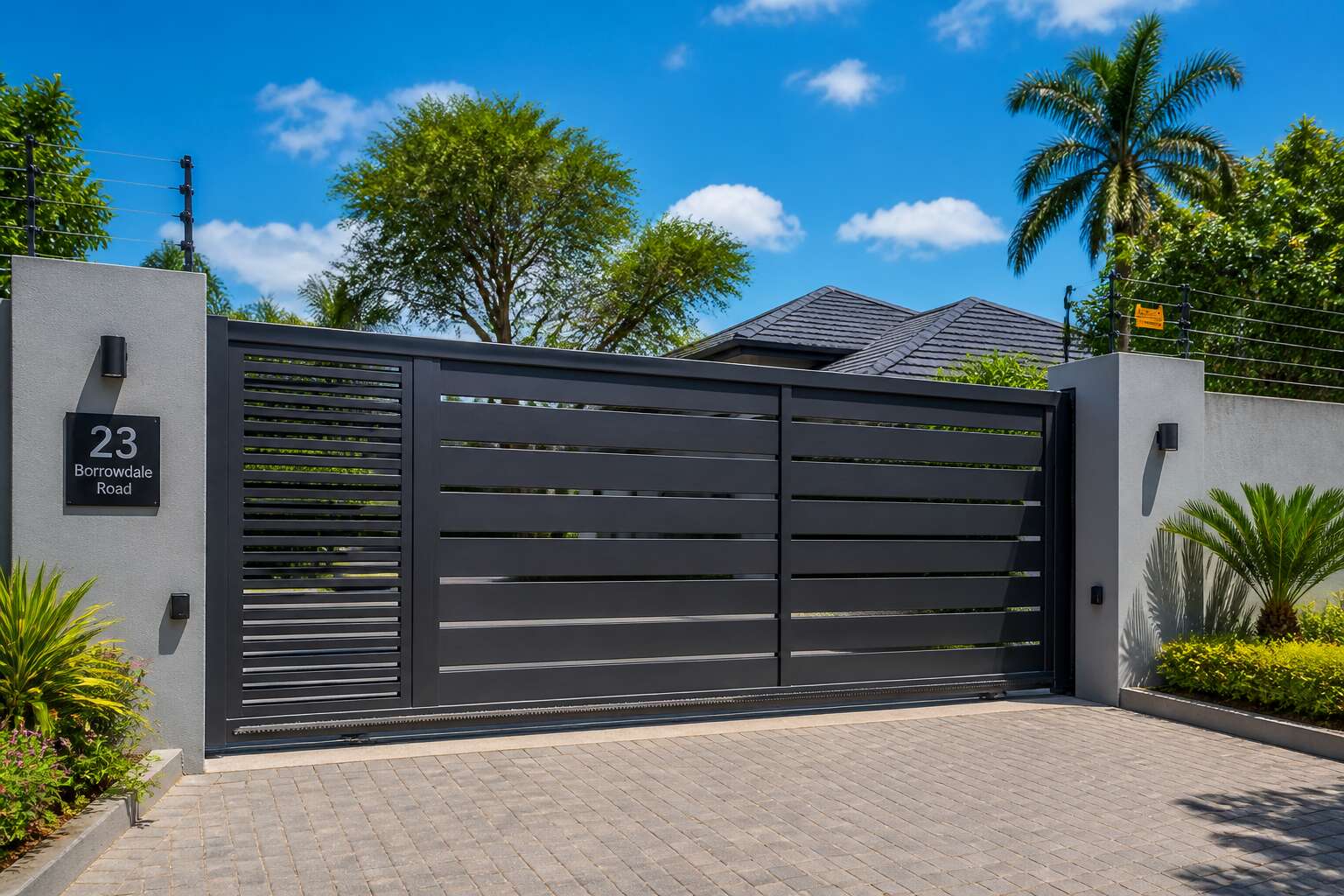
Residential and commercial properties approach a sliding gate zimbabwe with distinct priorities. Homeowners pick palisade or lattice infills for an open look and less wind resistance. Commercial sites lean toward solid sheeting to block sight lines and withstand impact.
The track system reveals the core difference. A cantilever gate rides on rollers inside a hidden beam, with no ground contact, so it glides over gravel or slight gradients. A V-track gate uses a bottom wheel in an exposed rail, simpler to install but vulnerable to dirt. Here is a practical summary:
- Cantilever handles long spans and frequent use without ground obstruction.
- V-track fits short driveways with clean, paved surfaces.
- Cantilever demands a higher initial investment but reduces upkeep.
Ornamental Wrought Iron Options
Nothing announces a property’s character quite like the gate that guards it. In Zimbabwe, where both sweeping farm estates and urban commercial lots demand distinction, the sliding gate zimbabwe market offers two dominant aesthetic paths. For homes, palisade barriers with vertical steel blades create rhythm and light, allowing breezes to pass while still asserting a clear boundary. Lattice infills add geometric charm, like a woven steel fabric that softens the industrial edge. I have seen these on family homes in Harare’s northern suburbs, where they frame the entrance with quiet elegance. For commercial yards, solid sheeting presents a fortress like silence, blocking all sight lines and resisting scrapes from forklifts or delivery trucks. The choice is not about taste alone; it reflects how the owner wants the world to perceive their domain.
Ornamental wrought iron remains the aristocrat of gate styles. Its twisted scrolls and forged finials carry a handcrafted memory, each curve a fingerprint of the blacksmith’s fire. A sliding gate zimbabwe designed in this tradition turns the mechanics of entry into a ceremonial moment. The metal moves on hidden rollers, yet the eye rests on the artistry above the beam.
- Residential favourites: spear top, scroll patterns, and leaf motifs
- Commercial staples: flat bar and mesh combinations for visibility with strength
That wrought iron finish works beautifully for boutique hotels or private vineyards, where the gate becomes a prelude to the landscape beyond. Yet it also suits secure compounds, because dense scrollwork is surprisingly difficult to climb. I always advise clients to consider the weight, since ornamental sections are heavier than standard palisades. The reward is a gate that whispers permanence rather than shouting utility.
Automated Sliding Gates with Remote Access
Remote access has transformed the ordinary sliding gate zimbabwe from a simple barrier into a quiet convenience. Pressing a button while waiting in a Harare traffic queue saves time and spares you from climbing out into the rain. The automation is not a luxury anymore; it is becoming an essential feature for homes and warehouses alike.
Popular residential styles lean toward clean lines and minimal ornamentation. A few favourites dominate the orders we see:
– Internal beam designs with a smooth face
– Flat top palisades with galvanised finishes
– Double skinned gates for noise reduction
Commercial properties often choose solid profile sheeting on a heavy frame. The motor unit must be sized correctly, since a gate that drags on uneven ground will strain the gears. A well installed sliding gate zimbabwe with a reliable remote system gives you control without the drama. Simple, practical, and quietly dependable.
Heavy-Duty Gates for Industrial Premises
A warehouse gate opens more times in a day than a home gate does in a month. That changes the requirements. Residential styles in Zimbabwe lean toward lattice inserts and lightweight profiles, while commercial sites prefer reinforced box-section frames. For industrial premises, the priorities shift.
A sliding gate zimbabwe must cope with forklift traffic, high winds, and constant use. Heavy-duty builds use solid steel panels, welded bracing, and anti-corrosion coatings. Many warehouses choose galvanised mesh infills for visibility and security.
- Track load capacity
- Wind rating
- Cycle life expectancy
A gate opened 500 times a day needs different runner wheels and hinges than one opened twice a week. That difference matters more than the finish. Choose the grade that fits your site’s actual conditions.
Choosing the Right Materials for Long-Lasting Performance
Galvanized Steel for Corrosion Resistance
Corrosion causes more gate failures than mechanical wear. For a sliding gate Zimbabwe, material choice determines lifespan more than any design feature. Galvanized steel resists rust through a zinc coating that corrodes sacrificially, protecting the base metal. This matters in coastal regions where salt air accelerates deterioration.
Hot dip galvanizing yields a thicker coating than electro galvanizing. Coating weight and the treatment of cut edges after fabrication separate durable gates from temporary ones.
- Zinc coating thickness varies by application
- Welds require extra protection after fabrication
- Sharp bends may crack the galvanized layer
Galvanized steel for a sliding gate Zimbabwe performs reliably under harsh conditions. The material’s corrosion resistance reduces the frequency of replacement.
Aluminum Lightweight Alternatives
Aluminum gives you a lighter option for a sliding gate Zimbabwe. A gate that weighs less places less strain on tracks, rollers, and the drive motor. It also reduces the load on supporting posts, which can lower the cost of concrete and steelwork on site.
Aluminum brings several useful properties to gate fabrication:
- It forms a natural oxide layer that resists corrosion without additional coating.
- Extruded sections allow clean, modern profiles that suit residential and commercial settings.
- The metal is easy to cut and weld, so fabricators can match exact opening widths.
That combination matters for sites where soil movement or lighter structures make a heavyweight gate risky. The lower moving mass often extends the life of the motor and wheel components.
Powder-Coated Finishes for Weather Protection
Few components endure the punishment of a sliding gate Zimbabwe, from harsh UV rays to windblown grit. The choice of material determines how gracefully it ages. While structural steel provides the rigidity needed for wide openings, its survival rests on the finish applied at the factory.
Powder coating stands as the preferred defense. The process fuses a thermoplastic layer to the metal, creating a smooth surface that resists chipping, fading, and corrosion. Unlike wet paint, it does not drip or leave thin spots. For a sliding gate Zimbabwe, this uniformity prevents weak points where rust could begin.
Stainless Steel Hardware and Fittings
Most people never see the hardware that makes a sliding gate Zimbabwe work, but they certainly notice when it fails! Stainless steel hardware and fittings determine whether that smooth glide remains smooth for years or turns into a grinding, squealing ordeal.
Bolts, brackets, rollers, and hinges face constant friction and exposure. Mild steel fittings will rust from the inside out, often hidden from view until failure. Stainless steel, specifically marine grade 316, resists pitting and staining in high dust and humidity conditions.
For high traffic properties, the components that matter most are:
- Roller bearings sealed against grit
- Tension pins that allow easy adjustment
- Threaded inserts that prevent galvanic corrosion between dissimilar metals
Timber and Composite Accents
Choosing materials for a sliding gate Zimbabwe demands a careful read of the environment. Timber delivers character. Composite delivers resilience. The two together create a gate that feels alive without exhausting the owner.
Hardwoods like Balau and teak withstand moisture and insect pressure. Composite boards never split, never fade, and never need oiling. Match the material to the exposure.
- Balau decking for a natural, dense surface
- Composite slats for uniform colour and smooth maintenance
- Aluminium frames with timber veneer for reduced weight
Weight changes the engineering. A heavier timber gate requires reinforced wheels and a stronger drive motor. A composite alternative lightens the load while preserving the look.
Site Assessment and Installation Essentials
Measuring the Gate Opening and Clearance
Before any steel is cut or motor ordered, the actual dimensions of your entrance must be verified on site! I have seen installations fail because someone trusted an old drawing instead of a tape measure. The gate opening width is measured between the posts at the ground and again at head height, because masonry settles and concrete spalls.
Clearance is a separate concern. A sliding gate zimbabwe site needs roughly one third of the gate length for the counterweight and slide path. That space must remain free of drainage channels, wiring conduits, and fencing posts. The gradient across the track also matters, since a two centimeter difference can bind the wheels.
- Measure the opening at three heights per post.
- Verify the slide path equals the full gate length plus twenty percent.
- Confirm ground flatness over the entire travel distance.
Locking these numbers down allows the brackets and motor mount to be positioned accurately for any sliding gate zimbabwe project.
Ground Conditions and Foundation Requirements
The ground beneath a sliding gate zimbabwe installation is rarely given the scrutiny it deserves. Soil that appears stable in the dry season can soften dramatically after a week of rain. Before any concrete is mixed, verify the bearing capacity of the actual earth at each post position. In my experience, this step gets skipped far too often!
A simple probe test often reveals hidden pockets of decomposed granite or loose fill material that will settle unevenly under the weight of a motorised gate. The assessment should cover:
- Bearing capacity at each post location
- Drainage behaviour across the full travel path
- Depth and composition of any fill material
The foundation itself should be poured as a continuous reinforced beam, not isolated pads, because the track and gate posts must move as a single unit. That distinction matters for every sliding gate zimbabwe project, particularly where seasonal swelling clays can shift a poorly anchored structure by several centimetres.
Electric Motor and Track Alignment
Nobody notices a perfectly aligned track. That is precisely the point. For a sliding gate zimbabwe, the motor and track either work as a system or destroy each other. When they fall out of agreement, the grinding screech of metal on metal will announce it at 3 a.m.
Alignment starts with the horizontal plane. The track must sit level across its full run, with the gate’s wheels meeting it under equal pressure. A five millimetre difference forces the motor to compensate every cycle, wearing the drive sprocket and gearbox prematurely.
- Check track straightness with a taut string line, not a tape measure.
- Verify motor mounting bolts meet the torque specification.
- Test limit switches before applying full power.
The motor needs a rigid base plate. A flexible mount transmits vibration into the gearbox and strips the teeth off the drive sprocket. This matters especially where daily dust and heat accelerate wear on any sliding gate zimbabwe installation.
Safety Sensors and Emergency Override Systems
Before a single post is sunk, the soil beneath a sliding gate zimbabwe must be tested. A percussive survey reveals hidden voids, while a moisture check guards against seasonal heave. These two steps cost an hour and save a decade of corrective work.
Safety sensors deserve equal attention. Photoelectric beams catch a child’s shadow before the gate moves. Pressure edges stop the gate on contact, and an emergency manual release lets a person disengage the motor by hand. For any sliding gate zimbabwe, the installation sequence matters:
1. Mount sensors along the full travel path.
2. Test the manual release monthly.
3. Label the override clearly for every user.
A gate without these layers offers no protection beyond its own motion.
Local Regulations and Permits in Zimbabwe
Site work in Zimbabwe begins with municipal approval, not concrete. The local council wants to see a drawn plan of the boundary, the gate line, and the setback from the road. Many property owners skip this step and then face a stop order midway through installation. A sliding gate zimbabwe installer should verify these requirements before excavation, because the regulations vary by town. Harare’s process differs from Bulawayo’s, and rural districts have their own rules entirely. The assessment also covers access: how the crew will move materials to the post line, and where the spoil will go.
Here is what the council typically checks:
– The gate’s swing or slide path relative to the public walkway
– The depth of the foundation trench and its distance from sewer lines
– The electrical connection point for the motor and its earthing
A formal inspection may follow the pour. The permit notice stays visible on site until the work passes. Without that document, even a well engineered sliding gate zimbabwe can become a liability rather than an asset.
Security and Access Control Benefits
Deterrence Against Intruders and Vehicle Theft
A stolen vehicle disappears into the darkness of a Bulawayo industrial strip. The driver never even attempts the driveway protected by a motorized sliding gate zimbabwe. Why? Because criminals read opportunity, and a solid, slow-moving barrier removes it entirely. The visual weight of that gate alone sends a message: this property will fight back.
That psychological edge is real, and I have seen it hold in practice. Properties with defined access points face fewer smash-and-grab attempts. The gate compresses entry into one observable choke point, which changes the math for anyone planning a quick vehicle theft.
- Stops ram-raids before they begin
- Forces intruders into monitored zones
- Secures parked fleet vehicles from night-time snatch-and-go crews
Access control tightens this further. A keypad or card reader means only authorised drivers move in or out. No tailgating, no open gaps. For Zimbabwean homeowners and business owners alike, that control is the difference between a target and a fortress.
Integration with Intercom and CCTV Systems
A sliding gate zimbabwe becomes a managed access point when linked to intercom and CCTV systems. The gate itself holds the boundary, but the connected electronics identify who stands before it. Visitors state their purpose through the intercom. Cameras capture faces, registration plates, and timestamps for each approach. Entry becomes a verified event rather than a mechanical action.
Property managers watch the sliding gate zimbabwe feed from a single workstation and release the gate remotely. They no longer need to walk to the perimeter for every delivery or guest. The system logs all movements, and that data settles disputes with certainty.
- Verification happens before the gate opens
- Footage provides a clear record of every entry
- Remote release handles deliveries without staff exposure
For commercial yards and residential estates, this integration is the practical core of a secure perimeter.
Manual Locking Mechanisms as Backup
A power cut turns a smart gate into a static barrier. Automated systems stop. The gate stays shut, but so does the security it provides. A sliding gate zimbabwe needs a manual locking mechanism as its backup.
Manual locks work without electricity. A drop bolt slides into a floor receiver. A padlock secures the latch. These components are simple, robust, and effective.
- The gate remains locked during load shedding.
- Intruders cannot exploit an unpowered motor.
- Staff can secure the perimeter manually.
Property owners who invest in automation sometimes overlook this backup. They should not. The manual lock is the difference between a secure gate and a vulnerable one.
Perimeter Security for Farms and Estates
There is a fine line between a secure farm and a fortress, and the driveway is where that line gets drawn. For estates and agricultural holdings, the perimeter is not merely a boundary. It is the first and most critical line of defense against theft, livestock rustling, and trespass. A sliding gate zimbabwe provides a controlled single point of entry that transforms a porous property into a managed space.
Access control on a sliding gate zimbabwe goes beyond simply opening and closing. It allows management to screen every visitor, delivery vehicle, and worker before they pass the threshold. This screening process is where operational security truly begins. A farm manager can observe a vehicle, assess its occupants, and decide whether to grant entry without ever leaving the office. This distance is a tactical advantage, not an inconvenience.
The physical design of a sliding gate also prevents a common farm vulnerability: the rushed exit. A sliding gate zimbabwe moves laterally along a tracked system, which prevents the vehicle from rolling backward or forward during the opening sequence. This stability is vital when moving heavy machinery or livestock trailers through the entrance. The gate also eliminates the wide swing arc of a hinged alternative, meaning a driver cannot clip a post or force the mechanism open with a bumper.
For estates, the benefits compound daily.
– Contractors gain access only during registered working hours.
– Domestic staff can be assigned specific entry codes for afterhours movement.
– Delivery drivers remain visually monitored from the guardhouse until departure.
– Visitors are logged in and out with a simple intercom request.
This level of control does not require constant human attention. The security infrastructure of a sliding gate zimbabwe works quietly in the background. It records activity without opinion, and it denies entry without confrontation. The gate becomes a silent employee, one that never sleeps and never takes a bribe.
The security benefits extend to the gate’s own structural integrity. Sliding gates are inherently resistant to being rammed by a vehicle. Because the gate runs on ground wheels and a guide rail, it does not rely on heavy hinges that can be sheared off with a tow rope. This construction makes it a formidable barrier against smash-and-grab theft, a tactic often used to target farm equipment and estate vehicles. The gate absorbs impact force horizontally and distributes it along the entire track, which makes a forced entry a noisy, time-consuming, and ultimately unsuccessful endeavour.
A sliding gate zimbabwe is not just a door. It is a permission system, a timekeeper, and a deterrent in one motion. When the perimeter is armed with this level of control, the rest of the property can operate with a quieter mind.
Maintenance, Repairs, and Long-Term Value
Routine Cleaning and Lubrication Tips
The first sign of trouble is a shudder. A sliding gate zimbabwe that once glided now jerks. That jerk means wear on every moving component. Ground dirt and mineral dust embed themselves in the wheel bearings and track, turning smooth motion into abrasive friction.
Routine cleaning changes that trajectory. I have seen systems fail because owners ignore soil and debris buildup. A pressure wash clears the track, but lubrication is equally critical. Use lithium-based grease on rollers and light oil on the rack. For any sliding gate zimbabwe, frequency depends on weather and usage, but consistency matters!
- Inspect the track for dents weekly.
- Check gearbox oil monthly.
- Listen for grinding sounds.
Repairs become expensive when these signs are dismissed. Replacing a seized bearing costs more than grease that prevents it. Long-term value comes from catching small problems early. A maintenance log turns guesswork into a schedule that protects your investment.
Identifying Wear on Wheels and Rollers
Wear on wheels and rollers rarely announces itself with drama. It shows up in subtle changes. A sliding gate zimbabwe that leans slightly while moving, or tracks with a rhythmic thump, has a problem. Flat spots on nylon rollers and pitting on steel bearings point to misalignment or overload. Ignoring these signs can leave the gate hanging off its track.
Check the wheel flanges for uneven wear patterns. Look for cracks in the roller brackets. Measure the gap between the gate and the ground, because sagging means the rollers are failing.
- Inspect each roller for side play.
- Check for metal shavings in the track.
- Test the gate manually for resistance.
These findings matter because a broken roller can bend the track and warp the gate frame. The repair cost multiplies when one component fails and takes others with it. For any sliding gate zimbabwe, early identification of wheel wear is the difference between a small fix and a full rebuild.
Cost of Replacement Parts in Zimbabwe
Maintenance costs for a sliding gate zimbabwe depend on how promptly repairs are handled. A seized bearing or bent track left unattended will force you to replace entire assemblies rather than single components. Local steel prices fluctuate, and imported rollers or motors carry a premium, so proactive upkeep is financially prudent.
Establish a quarterly inspection routine. Tighten loose bolts, check the gearbox oil level, and verify that the track has not shifted. A small adjustment today prevents a costly realignment tomorrow.
- Replace worn rollers in pairs to maintain even tracking.
- Use genuine parts for automated gates, as generic substitutes often fail quickly.
- Keep spare belts and bearings on hand to avoid downtime.
The long term value of a sliding gate zimbabwe lies in consistent care. The upfront cost of quality components and regular servicing is far lower than emergency repairs or premature replacement.
Extending Gate Lifespan Through Regular Servicing
Zimbabwe’s climate and dust take a measurable toll on moving machinery. A sliding gate zimbabwe cycles hundreds of times per month, and each cycle wears the motor, the bearings, and the track interface. Regular servicing catches these stresses before they compound into failure.
Repairs are not optional afterthoughts. A minor track shift or a worn pinion can strain the entire drive system. I have seen gates that cost twice as much to repair because a two-minute adjustment was deferred. The relationship between service frequency and repair cost is direct.
- Six monthly servicing sessions cost less than one emergency callout
- Factory authorised technicians identify issues that owners miss
- Documented service history raises the resale value of the property
Long term value flows from consistent attention to the sliding gate zimbabwe. The lifespan of a gate is not determined by its purchase price. It is determined by the discipline of its upkeep!
Energy Efficiency of Automatic Motors
An automatic motor on a sliding gate zimbabwe draws current on every opening and closing. Multiply that by hundreds of cycles a month, and the energy cost becomes a real line item. When the track sits out of line, or a roller binds, the motor works harder. That extra effort means wasted electricity! Maintenance and repairs restore the mechanical ease that keeps the motor in its optimal efficiency range. A clean, lubricated system lowers electrical draw, and that directly supports long term property value.
- Friction on the track and wheels
- Tightness of the drive chain or pinion mesh
- Voltage quality and controller calibration
Each of these responds to routine care. Ignoring them turns a modest power draw into constant overuse. Over a decade, the difference shows up on the electricity bill and in the lifespan of the motor.
Resale Value and Property Appeal
A sliding gate zimbabwe that moves with a dry, metallic groan is a portent. It tells visitors this property has been left to weather. The cost of neglect appears in the repair bill and in the eyes of a prospective buyer.
Repairs demand action before corrosion takes hold. A seized roller, a sagging track, a motor straining beyond its duty cycle; each fault compounds. The longer the delay, the deeper the damage. A buyer walks the boundary and notices the patched steel, the hesitation in the movement, the small scars that reveal deferred care.
Long term value emerges from the unglamorous details. A gate that opens with quiet certainty signals a property that was protected against time. That impression transfers directly to resale value. An estate with a failing entrance invites questions about everything else.

0 Comments