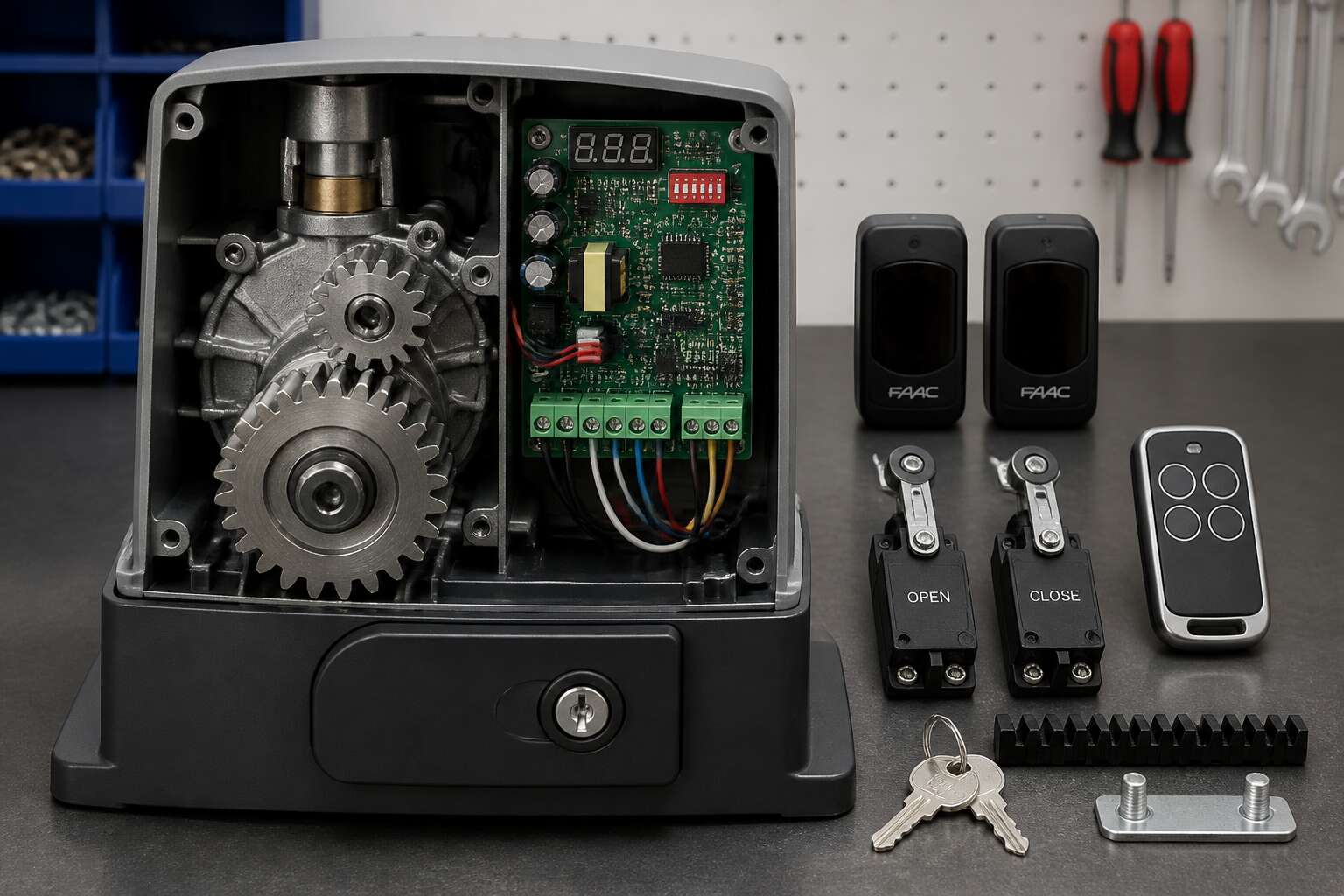
Anatomy of an Automatic Gate Opener
Key Drive Components
In a decade of servicing gates across Gauteng, I have watched the same pattern repeat. A sliding gate that refuses to move rarely fails for the obvious reason! The gearbox absorbs the brunt of every open and close cycle, and its nylon or steel gears wear unevenly under constant load. Choosing the right sliding gate motor spare parts means understanding this anatomy.
- The motor turns the worm shaft.
- The worm gear drives the output pinion.
- The pinion pushes the rack fixed to the gate.
A worn worm gear creates backlash, making the gate shudder and stall. Pinion teeth, often steel, show pitting from sand and corrosion. These parts, not the control board, cause most repairs in South African conditions. The quiet failures hide here, inside the drive train, before any electrical fault ever appears.
Electrical Control Elements
An automatic gate opener’s electrical system is where most homeowners notice trouble first. The control board manages every command, but limit switches and capacitors take the most strain. These sliding gate motor spare parts fail quietly. A capacitor that loses its charge makes the motor hum and stall. A limit switch that drifts out of alignment stops the gate a meter short of full closure.
- Limit switches
- Start and run capacitors
- Step down transformers
- Photocell sensors
Lightning surges in Gauteng claim more control boards than wear ever will. When the board fails, the gate will not move. Keeping a spare control board in stock is the difference between one lost afternoon and a week of manual operation.
Safety Mechanisms and Sensors
Safety mechanisms are what separate a convenient gate from a dangerous one. In South Africa, high winds and uneven driveways place constant physical stress on these sensors. A safety edge, the rubber strip mounted along the gate’s leading edge, compresses on contact and signals the motor to reverse immediately. Obstruction detection works through current sensing. The motor draws more power when it meets resistance, and the control board interprets that spike as a blockage.
Common sliding gate motor spare parts in this category:
- Safety edge contact strips
- Torque sensors
- Warning light assemblies
- Loop detector modules for vehicle presence
These parts fail gradually rather than suddenly. A worn safety edge may still trigger, but with a slight delay. That delay matters when a child or pet is near the gate. A gate that cannot sense an obstruction is a gate that can cause harm.
Housing and Structural Parts
A gate motor housing does not whisper. It works in direct sunlight, heavy rain, and the kind of wind that bends trees. In South Africa, the housing is the first line of defense against the elements, and the structural parts are what keep everything aligned. Most homeowners never think about the housing until rust creeps in or a bracket snaps under strain. The plastic and metal shells that cover the motor are not cosmetic. They are engineered to shield the electronics and the drive components from moisture and dust.
The structural integrity of the gate system relies on more than the motor itself. The gear rack, mounting brackets, and guide rollers all bear the constant weight of the gate leaf. When these parts weaken, the motor compensates, and that extra strain shortens its life. The most common sliding gate motor spare parts in this category are not glamorous, but they are essential.
– Rack and pinion gear sets
– Mounting bracket assemblies
– Guide roller wheels
– Housing covers and seals
A cracked housing cover lets dust settle on the control board. A worn gear rack skips teeth under load. Both failures start small and end with a gate that moves with hesitation. The gate’s physical frame and the motor’s shell perform an unspoken partnership. When one fails, the other pays the price. Pay attention to the silence of the structure. It often speaks before the motor does.
Identifying Parts That Require Regular Replacement
Gears and Rack Systems
Gears and racks carry the raw force of every gate movement. The teeth engage repeatedly under heavy load, and fatigue shows first in their contact faces. A worn rack develops a characteristic shine, while a damaged gear may skip or bind. Your sliding gate motor spare parts should include these items on a scheduled inspection list.
Watch for these warning signs:
- Cracks or chips on tooth flanks.
- Accumulated dust and debris in the root.
- Irregular gate speed during travel.
Replacing these parts at the right moment protects the motor gearbox from shock loads. In South Africa, abrasive wind and sun accelerate wear. Choose racks with induction hardened surfaces and gears with proper lubrication channels. Quality sliding gate motor spare parts reduce downtime and extend the life of the entire system.
Limit Switches and Microswitches
Limit switches and microswitches absorb the electrical chatter of every cycle. Their contacts erode over time. A failing switch often feels intermittent. The gate may hesitate before closing. These components are small, but they rank among the most overlooked sliding gate motor spare parts. Heat from the South African sun accelerates plastic fatigue in the switch housings. Vibration loosens terminal screws.
- Discoloured contact points.
- Brittle actuator arms.
- Sticky operation after rain.
Replacing these parts requires no guesswork. Measure the switching voltage and inspect the lever travel. Quality replacements cost little compared to a damaged control board.
Drive Belts and Chains
Drive belts and chains handle the brutal arithmetic of daily automation. In South Africa, where heat and dust are relentless, these tension carriers stretch, crack, and shed teeth. A belt that whines at dawn or a chain that develops a rhythmic clatter is signalling fatigue. The rubber perishes, the links elongate.
Look for telltale signs like polished teeth on the belt or rust-coloured dust where the chain turns. Uneven wear on the idler sprockets often reveals a chain that has outlived its true pitch.
Sourcing the right sliding gate motor spare parts for your belt and chain system matters. The correct sliding gate motor spare parts extend the service life of the drive. Choose parts that match the original manufacturer specifications. Many local installers choose reinforced belts with steel tensile cords. Chains need periodic lubrication, but even meticulous maintenance cannot defeat metal fatigue. These parts are sacrificial by nature.
Capacitors and Power Supplies
A capacitor is the first component to fail in most gate motors. South African heat and dust turn a five year lifespan into two. These small cylinders store the electrical charge that starts the motor. When they weaken, the gate hesitates or refuses to move. Power supplies convert the incoming voltage, and they also suffer from heat and load fluctuations.
- Bulging tops or leaked electrolyte on the capacitor body
- Burning smell or discoloured PCB near the power supply
- Gate moving slower than usual after a power surge
Replacing these units with sliding gate motor spare parts prevents erratic behaviour. The correct sliding gate motor spare parts match the microfarad rating and voltage tolerance. Power supplies need current capacity for the motor’s demand. I have seen gates fail during a power cut because the capacitor could not deliver that surge. Regular inspection of these two components saves you from unexpected lockdowns.
Remote Control and Receiver Boards
Remote controls and receiver boards are the most abused components on a sliding gate. Heat dries out the rubber buttons, while dust settles into the receiver’s crystal oscillator. I often see gates open for one neighbour and ignore the next, purely because of signal drift.
- Gate activates only when you stand right next to it
- Button needs several firm presses
- Other remotes, like car keys, cause interference
Replacing these units with sliding gate motor spare parts restores dependable operation. The correct receiver board matches the frequency band and rolling code format. Mixing brands breaks the code algorithm, and the gate may hesitate even after replacement. Transmitters and receivers wear as a pair, so swapping both at once is the practical route. Quality sliding gate motor spare parts cost less than the chaos of a locked gate on a stormy Friday afternoon!
Factors to Consider When Purchasing Replacements
Brand Compatibility and Model Numbers
Nothing derails a repair faster than assuming a generic part will slide right in. In the South African market, where power surges and harsh weather punish motors daily, the brand stamped on your existing unit matters more than the price tag. A Centurion motor will not accept an ET component without significant modification. I have seen homeowners learn this the hard way.
The model number is the definitive specification for your sliding gate motor spare parts. It dictates the gear ratio, the limit switch configuration, and the mounting hole spacing. A single digit difference, say a 4 instead of a 5, can mean a completely different shaft diameter.
Before you order sliding gate motor spare parts, locate the spec plate on the motor housing. You need to match three things perfectly:
- The manufacturer’s exact series name
- The model number suffix indicating voltage
- The physical mounting dimensions
Taking those details to your supplier ensures the replacement functions identically to the original. Overlooking them turns a simple fix into a weekend project.
OEM Versus Aftermarket Options
In South Africa, the aftermarket parts sector moves billions of rand annually, yet a large portion of those components never survive a single Highveld storm season. That statistic should shape every purchasing decision regarding sliding gate motor spare parts.
OEM components, stamped with the original manufacturer’s branding, command a premium because they match the engineering tolerances of your motor exactly. Aftermarket options tempt with lower prices, but quality varies considerably. Some are reverse engineered copies; others are factory seconds sold through unofficial channels.
Weigh these factors before committing:
- Warranty validity and whether a non accredited installer voids it
- The supplier’s return policy for defective or incorrectly sized units
- Any certification marks on the aftermarket component
I have watched homeowners save R200 on a gearbox only to replace the entire motor three months later. The cheapest components often become the most expensive.
Material Quality and Durability
The metal in your gate motor’s replacement gearbox determines how long the unit lasts. Coastal air corrodes unpainted alloys. Highveld sun degrades unprotected thermoplastics within a year. I have opened housings after two seasons to find pulley wheels crumbling into fragments!
When judging durability, look at the spec sheet, not the marketing copy:
- Zinc alloy versus pressed steel
- IP rating for water and dust ingress
- UV stabilisers in any polymer components
- Surface treatment such as anodising or e coating
These four factors decide whether your sliding gate motor spare parts survive a full summer thunderstorm cycle. Material certificates from the supplier disclose the exact alloy and coating. The packaging rarely reveals the true composition. A component that rusts from the inside, sealed behind a clean outer shell, fails silently.
Step-by-Step Guidance for Fitting New Components
Tools Required for the Job
The trick to replacing any component lies in the sequence, not just the strength of your grip. With the right sliding gate motor spare parts on the bench, you must first isolate the mains supply and discharge any capacitors. A multimeter set to continuity mode becomes your best friend here. For the physical swap, gather these essentials:
- Hex keys and a socket set sized to the fasteners
- A torque wrench to avoid overtightening aluminium housings
- Screwdrivers with insulated shafts
- A pry bar for stubborn gear couplings
Once the old part is free, compare the shaft profiles and mounting holes against the new unit. A dry fit reveals mismatches before you apply threadlock. Then tighten everything in a cross pattern to keep the load even. After reconnecting the wiring, run a manual jog test before restoring full power. That sequence saves hours of troubleshooting later.
Safe Removal of Worn-Out Parts
The old part has finally surrendered, which means your sliding gate motor spare parts are about to earn their keep. Removing a worn gear assembly without damaging the housing is a matter of patience, not force. Work through these steps in order:
- Loosen each fastener a turn at a time, moving around the bolt pattern in a spiral.
- Check for a hidden grub screw on the shaft before attempting to pull anything.
- Apply penetrating oil and wait ten minutes before any prying.
Finding that grub screw only after snapping the casting is a mistake you make once. Now, for the fitting stage. Wipe the mounting faces of the new sliding gate motor spare parts and inspect the locating dowels. A bent dowel throws everything out of alignment. The replacement should seat with minimal persuasion. If it needs a hammer, something is wrong. Align the bolt holes, apply threadlock sparingly, and tighten in a star pattern to preserve the gear mesh.
Proper Alignment and Calibration
When fitting new sliding gate motor spare parts, alignment begins before the first bolt touches thread. The mounting face must be clean. Check the dowel pins with a straight edge. A bent pin will distort the gear mesh under load, and that distortion becomes a knocking sound within a week.
Calibration follows a simple sequence:
- Fit the gear assembly and rotate it by hand through one full revolution.
- Check the backlash against the rack. It should feel firm, not tight.
- Tighten the fasteners in a star pattern, then recheck the backlash.
This final check matters most. The housing can flex when bolts are torqued. If the mesh feels tight after tightening, you have a shimming problem, not a torque problem. Sliding gate motor spare parts will fail early when alignment is guessed rather than measured. Take the extra ten minutes.
Testing Safety Features After Installation
Fitting new components demands a deliberate sequence. Start with the gearbox output shaft. Grease the splines before sliding the drive gear into place. A dry fit feels acceptable until the first rain, then corrosion changes everything.
- Mount the motor bracket loosely, leaving 3mm of play.
- Slide the rack into mesh with the pinion.
- Rotate the pinion by hand to confirm free movement.
- Tighten the bracket bolts, then recheck the mesh.
Once the mechanical side is solid, turn to safety. The sliding gate motor spare parts that protect people deserve more than a glance. Test the obstruction sensor with a solid object in the gate’s path. The gate must reverse within half a second. Break the photocell beam mid-cycle. If the gate does not stop instantly, do not commission the unit. I have seen a faulty sensor turn a routine service into a hospital visit. Genuine sliding gate motor spare parts are the only ones I trust with that test.
Lubrication and Ongoing Care
Roughly eight out of ten gate motor failures in South Africa trace back to poor lubrication, not worn electronics. Fitting new components is only half the job. The other half is keeping them alive. Mark the lubrication schedule on your calendar before you close the toolbox.
Start with the moving parts. Apply lithium grease to the rack teeth, the pinion, and the hinge points. Wipe away old grease that has gathered dust and grit. That abrasive paste wears down metal faster than motor strain does.
- Clean the gear teeth with a stiff brush.
- Apply fresh grease in a thin, even layer.
- Oil the motor shaft bearings with machine oil.
- Check the manual for brand specific grease points.
Every three months, inspect the sliding gate motor spare parts that take the most punishment. Look for rust on exposed shafts and check that the drive gear has not slipped. A well maintained unit lasts years longer than a neglected one.
Common Installation Mistakes to Avoid
Fitting sliding gate motor spare parts follows a deliberate order. Mount the new drive component loosely, then tension it only after the rack sits properly aligned. Tightening everything at once invites binding and premature wear.
The most common installation mistakes come from rushing. Mixing bolt sizes, skipping washers, or forcing a stubborn part into place creates stress fractures that show up later. Torque specs matter!
Work through this sequence:
- Position the component by hand.
- Hand tighten all fasteners evenly.
- Run one full cycle slowly.
- Recheck torque and clearances.
Finding Trusted Suppliers for Gate Motor Components
Authorized Dealers and Distributors
Finding trusted suppliers for sliding gate motor spare parts in South Africa requires careful checks. Authorized dealers and distributors offer verified warranties and exact compatibility.
I always check whether the supplier appears on the manufacturer’s official channel. A genuine part carries a unique serial number. Here are three signals that a supplier deserves your trust:
- A written guarantee matching the brand policy.
- Stock across multiple gate motor brands.
- A distributor certificate shown on request.
The cheapest option often costs more when a failed motor damages your gate. Stick with proven partners for these components. A broken gate is a security risk.
Online Marketplaces Versus Local Stores
Online marketplaces present a paradox. They offer convenience and vast catalogues, but they also host sellers who vanish after a sale. Local stores in South Africa let you hold the component in your hand before paying. You can feel the weight of a gearbox housing or inspect the copper windings in a motor. That tactile verification matters when you need reliable sliding gate motor spare parts.
When I source components, I weigh several factors:
– Shipping timelines from overseas sellers often stretch past two weeks.
– Return policies on marketplaces frequently exclude electrical parts.
– Local suppliers offer immediate replacement if a part fails during installation.
A marketplace listing may show a pristine photo, yet the actual item can arrive with worn threads or a mismatched bracket. Local stores answer questions directly and show you the stockroom. For critical electrical components, the extra cost of buying locally pays for itself in reduced downtime and simpler returns. The same principle guides every purchase of sliding gate motor spare parts, whether the supplier sits nearby or across an ocean.
Warranty and Return Policies
When you purchase sliding gate motor spare parts, the warranty tells you how much confidence a supplier has in their stock. A supplier who hesitates to put terms in writing is signalling something important.
I always ask three questions before committing to a purchase:
1. Who honours the warranty if the supplier closes?
2. What is the return window for electrical components?
3. Are replacement parts shipped before the faulty unit is returned?
These answers separate established suppliers from fly-by-night operators. A written warranty on sliding gate motor spare parts should cover manufacturing defects, not installation errors. Return policies in South Africa often require the original packaging and proof of purchase. Keep both until the part has worked for at least a month. That habit has saved me from losing money on faulty capacitors and receivers.
Reading Customer Reviews and Ratings
Finding a supplier for sliding gate motor spare parts in South Africa begins with customer reviews. Reviews reveal more than product quality. They expose how a supplier behaves when a capacitor fails or a receiver board arrives with a bent pin.
Look for patterns in the ratings. A single angry review is noise. Three reviews mentioning slow dispatch, or two describing a supplier who stopped answering calls, tell you more. I also search for reviews from electricians and gate installers. Their standards are higher than a homeowner’s.
- Reviews that mention specific part numbers.
- Responses from the supplier to negative feedback.
- Ratings spread across Google, HelloPeter, and Facebook.
Trusted suppliers earn their reputation through consistency. When you find one who stocks genuine sliding gate motor spare parts and stands behind them, hold onto that relationship!




0 Comments