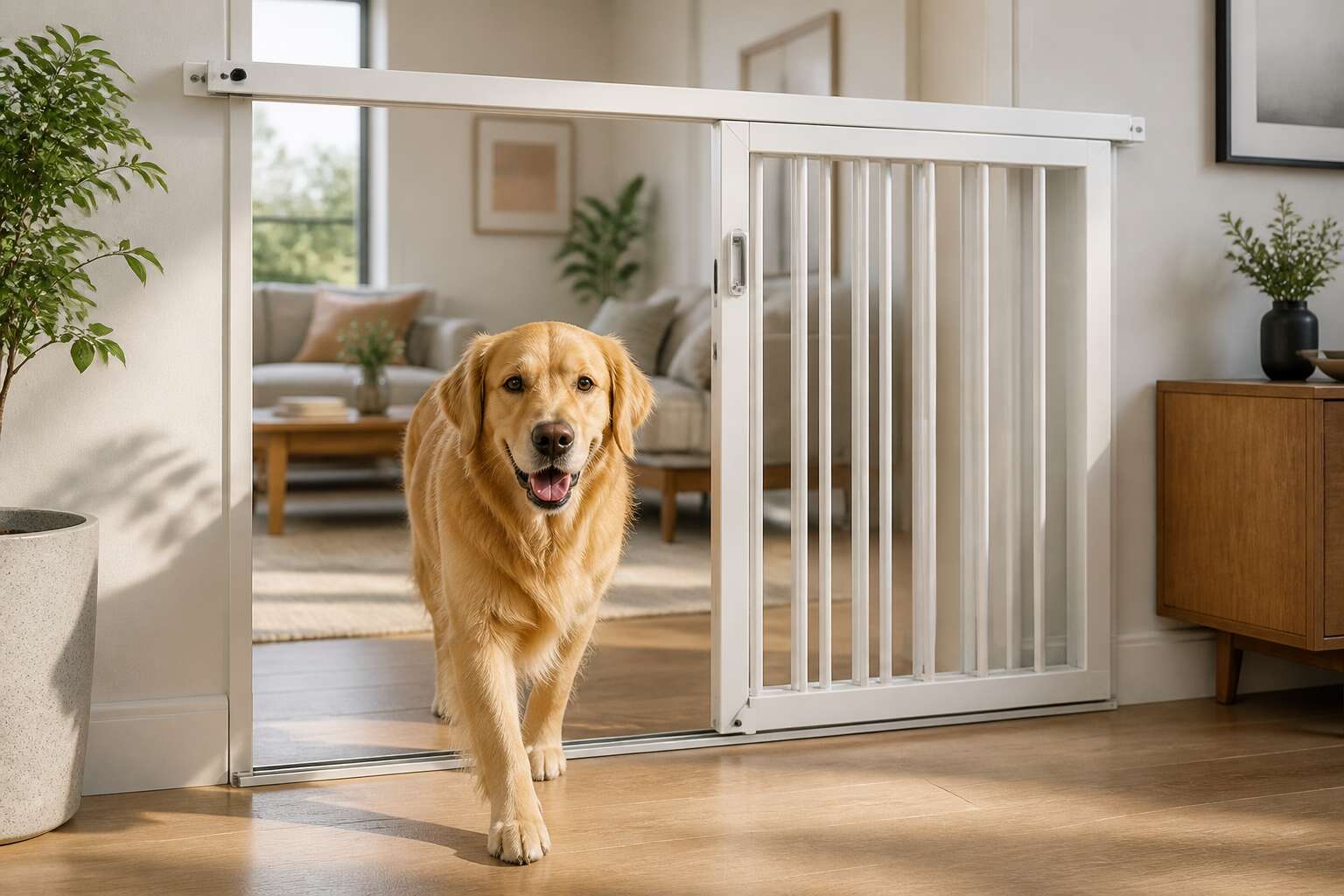
Understanding Space-Saving Pet Barriers
Why Traditional Gates Fail in Tight Spaces
In a typical Johannesburg townhouse, a standard swing gate eats up nearly a square meter of floor space. That is valuable room in a hallway or kitchen. Traditional pressure-mounted gates also rely on doorframes that are often too wide or too narrow, leaving gaps a determined dog can exploit.
Sliding gates for dogs solve this by moving along a track, not into your living area. They fit flush against a wall and work in openings where a swinging panel simply cannot. For narrow passages or awkward corners, this design makes them the practical choice.
- No floor clearance needed
- Works alongside furniture or staircases
- Mounts securely without damaging trim
I have installed these in spaces where a conventional gate would have blocked the only walkway. The difference is immediate and lasting.
Measuring Your Passageway Correctly
One surprising fact about passageways in Johannesburg townhouses: most are between 600 and 900 millimetres wide. That range determines your entire approach to space-saving pet barriers.
Sliding gates for dogs use a horizontal track, so they never intrude into the walkway. The real work is measuring your passageway correctly. Do it before you order anything!
Here is the process:
- Measure the width at three points: top, middle, and floor. Use the narrowest figure.
- Check the upper track space. You need at least 50 millimetres of clear wall above the opening.
- Look at the floor material. Uneven tiles change the bottom guide requirement.
These numbers decide the track length and mounting plates. The exact width prevents gaps along the edges. For sliding gates for dogs, a precise fit ensures stable operation.
Essential Safety Mechanisms for Pets
Sliding gates for dogs operate on a principle of controlled motion, where safety emerges from precision. The horizontal track holds the panel firmly, while the bottom guide keeps paws from slipping beneath. A soft-close mechanism, often overlooked, prevents the panel from slamming onto a snout. These elements work together to create a barrier that responds reliably, which is why sliding gates for dogs suit tight passageways.
Consider how the latch engages. It must be simple enough for human hands, yet resistant to a determined nose. The materials matter too. Anodised aluminium tolerates Johannesburg’s temperature swings without warping.
Essential safety mechanisms include the following components.
- A captured track that prevents derailment
- Finger-safe spacers along the leading edge
- A floor guide with rounded edges
Each component earns its place through function, not decoration. The result is a barrier that protects pets effectively while remaining unobtrusive.
Exploring Materials and Finishes
Aluminum and Stainless Steel Durability
In coastal South African towns, salt-laden air corrodes standard steel within months. That is why the choice of material for sliding gates for dogs determines their lifespan. Aluminum offers a formidable resistance to oxidation, yet it bends under repeated impact. Stainless steel, particularly grade 304, maintains structural integrity while enduring constant lateral force.
Consider the environment and the dog’s behaviour before selecting. Lightweight aluminum suits smaller breeds in sheltered yards. Heavy stainless steel serves larger, energetic dogs near the ocean.
- Aluminum: rust resistant, low maintenance, prone to denting
- Stainless steel: stronger, heavier, costlier, superior for saline exposure
Finishes also matter. Powder coating over aluminum prevents scratching, while brushed stainless steel hides paw prints effectively.
Tempered Glass Panels for Visibility
Watching a dog anticipate your arrival is one of life’s quiet pleasures. Tempered glass panels in sliding gates for dogs deliver this sightline without sacrificing security. Unlike acrylic, which scratches under enthusiastic paws, tempered glass withstands blunt force and harsh coastal sun. It also prevents snagged collars, since no gaps invite curious noses.
- Clear glass: unobstructed eye contact
- Frosted glass: softened light, calmer for reactive breeds
- Bronze tint: reduces heat while preserving movement cues
Finish selection alters behavior more than you might expect. A polished edge deters chewing, while a matte surface hides smudges from wet noses. For South African homes, this visibility turns a barrier into a communication tool, easing separation anxiety on both sides of the gate.
Wood Finishes for Warmth
Wooden sliding gates run quieter than their metal counterparts, a difference you hear before you see. For sliding gates for dogs, timber brings a warmth that stainless steel never will, turning a security barrier into a natural extension of the home.
South African conditions demand specific finishes. Marine varnish copes with the Highveld’s harsh ultraviolet rays. Hard wax oil preserves the grain but needs annual maintenance. Polyurethane forms a resilient barrier against water, mud, and persistent chewing.
- Raw linseed oil: deepens grain, requires yearly reapplication
- Water-based lacquer: low odour, dries quickly
- Two-part epoxy: heavy-duty protection, used on boat decks
Preparation decides whether the finish lasts. Progressive sanding, mineral spirit cleaning, and complete curing between coats determine the outcome. A matte surface conceals nose smudges, while a satin sheen brightens a dark passage. Wood moves with humidity, so a slight gap between boards prevents buckling in the summer months.
Hardware and Track Systems
Every sliding gate for dogs is only as dependable as its least impressive component: the track. The panels get the attention, but the wheels, rollers, and rail do the daily work. In South Africa, where dust from the Karoo winds and coastal salt challenge everything, the hardware finish matters as much as the material underneath.
Hot-dip galvanising offers the most honest protection for steel tracks. Powder coating adds colour but chips when grit gets trapped between the wheel and rail. Anodised aluminium resists corrosion without the maintenance. In my experience, sealed bearings outperform open ones; an open bearing will grind to a halt within months in sandy conditions.
For the track itself:
- V-groove wheels track truer than flat rollers
- A recessed bottom track stays clear of paws and debris
- Stainless steel rails suit coastal properties, while aluminium keeps weight down inland
Weather-Resistant Options for Outdoor Use
The South African sun does not negotiate. It fades, cracks, and oxidises whatever you leave outside, and your sliding gates for dogs are no exception. Finishes are the first line of defence, and most people pick based on colour swatches rather than climate reality. A glossy powder coat looks brilliant in the showroom, then peels like sunburnt skin after a few Highveld summers. You want something that laughs at UV rays and shrugs off humidity.
- Baked enamel: tough and wallet friendly, but demand UV-stable pigments
- Anodised aluminium: no chipping, though colour options stay limited
- Acrylic polyurethane: the coastal champion, with a hard, glossy barrier
Inland owners can get away with a decent zinc primer under a quality enamel. Coastal properties need the acrylic polyurethane or a marine grade finish. The right coating keeps sliding gates for dogs looking decent and prevents corrosion from eating through the frame. Remember, the finish is not decoration; it is the skin that decides how long the gate survives.
Installation and Adjustment Tips
Securing the Top and Bottom Tracks
A track that flexes is a track that fails, especially when a 40kg ridgeback decides to test it. For sliding gates for dogs, the top track carries the weight and the bottom track controls the swing. If either one shifts by a few millimeters, the gate starts to bind. Secure both tracks with anchor points every 300mm, not just at the ends. A spirit level is non-negotiable here.
- Mount the top track first, letting the gate hang naturally.
- Align the bottom track to the gate’s path, not to the floor.
- Tighten every screw to torque spec, not to feel.
Loose hardware in the bottom track is the most common fix we see on sliding gates for dogs. Adjust the gap between the tracks to match the gate’s thickness, then walk the gate through its full range. The smoothness you feel afterward is the reward.
Fine-Tuning the Slide Movement
There is a moment, after the hardware is set and the tracks are true, when a sliding gate begins to speak. You can hear it in the glide of the rollers, a soft hum that replaces the earlier stutter. We listen for that sound during every tuning session. A gate that hesitates, even for a second, is telling you about a wheel that sits at a crooked angle or a guide that grips too tightly.
We adjust the carrier wheels in small increments. A quarter turn of the hex nut often changes the entire personality of the gate. The bottom guides, which keep the gate from swaying, need a similar level of attention. We set them so they barely kiss the gate’s edge. When the gate runs through its full range, we watch for vibrations in the end caps. The smoothness you feel afterward, that silent roll, is the confirmation we seek. For sliding gates for dogs, this is where the craft lives.
Troubleshooting Common Alignment Issues
The first sign of trouble is rarely a loud noise. It is a small scrape at the bottom corner, or a gap that widens toward the top. For sliding gates for dogs, these quiet complaints usually trace back to how the track was mounted. I always check the rail with a laser level before bolting down the brackets. A difference of 3 millimetres across the span is enough to cause a persistent drag!
Alignment issues often appear in patterns. Take note of where the gate hesitates:
- It swings toward the fence at the end of travel: shim the outer bracket by 2 millimetres and retest.
- One wheel lifts off the rail: this signals a bowed track section, not a bad wheel.
- The top edge slopes noticeably: loosen the post anchor and tap it until the vertical line reads true.
During installation, torque each bolt with the gate closed, then again at mid travel. This dual pass reveals stress points that a static check misses. For sliding gates for dogs, a ten minute second inspection after the first week of use often prevents a bent guide roller later.
Matching Gates to Your Lifestyle
Considerations for Puppies vs. Adult Dogs
Dogs are either tiny demolition experts or seasoned quiet schemers. A puppy treats every sliding gate as a puzzle, while an adult dog views it as a bureaucratic obstacle. This distinction matters more than raw size.
Puppies need barriers that close flush to the floor, because their genius lies in squeezing a nose under a half-inch gap. Adults test the latch through sheer persistence, so a self-locking mechanism becomes non-negotiable. Consider these differences:
- Puppy phases: choose panels with no footholds, since climbing starts at eight weeks.
- Adult years: confirm the slide resistance matches a dog who has learned to push slowly.
Sliding gates for dogs accommodate both life stages when the track tension and stop pins are adjustable. A fixed gate suits one lifestyle, but a sliding system adapts to yours.
Gate Placement in High-Traffic Areas
High-traffic areas demand a different kind of thinking. The passage between the kitchen and the living room becomes a repeated obstacle when you share space with a dog. Sliding gates for dogs stay out of the swing path entirely, which matters when people carry groceries or navigate narrow hallways.
A gate that suits a quiet weekend retreat will frustrate everyone during weekday mornings. In busy zones, the gate should glide with one hand while you balance a coffee cup. Your lifestyle determines whether you need a pocket gate or one that rests against the wall. Sliding gates for dogs should match your movement patterns.
Some placements require extra thought:
- Doorways used by delivery personnel or visitors need gates that do not obstruct the threshold.
- Staircases in high-traffic zones benefit from gates that lock automatically after each pass.
Observe how your family actually moves through the home. The busiest opening usually deserves the gate.
Integration with Existing Home Decor
A gate tells the truth about a home. The most considered interiors treat every opening as a design decision, and a sliding gate for dogs is no exception.
In a Johannesburg loft, brushed aluminum matches exposed ducting. In a coastal cottage, a light timber frame complements the deck. The gate can disappear into the wall or stand as a deliberate piece of furniture.
Common integration approaches often look like this:
– A farmhouse kitchen pairs a stained oak gate with existing cabinetry.
– A minimalist apartment uses a flush steel panel, set back into the reveal.
– A property with high-end finishes chooses a gate with hidden hardware.
The track itself carries visual weight. A slim profile reads differently than a chunky floor guide. The choice should reflect the room’s material language and the owner’s sense of order.
Temporary vs. Permanent Solutions
Rental agreements change, puppies grow, and home layouts shift. A gate that works today may feel like a mistake next season. The real question is whether you need a solution that disappears when the door closes or one that becomes part of the wall itself.
Temporary installations suit people who move often or test a dog’s behavior first. Look for tension-mounted tracks or freestanding frames. Permanent options require cutting into the substrate and committing to a fixed slide path.
- Temporary: no drilling, simple removal, lower cost
- Permanent: seamless integration, sturdy operation, lasting value
Your lifestyle dictates the tradeoff. If the gate serves a single doorway for years, permanent wins. If you foresee rearranging rooms, go temporary. The best sliding gates for dogs correspond to how you actually live.
Remote-Controlled and Smart Gate Options
South African homes change with the seasons, just as dogs change with age. The right sliding gates for dogs must match the way your household actually moves. A remote controlled gate suits a family that spends afternoons outside. A manual option serves someone who wants simplicity and no dependence on electronics.
Smart gate options now bring the slide into your routine. Mobile apps offer status checks and remote opening. Motion sensors detect your dog and move the gate without a touch. Timers sync with feeding schedules, while notifications tell you when the gate last opened.
Think about what fits your specific environment:
1. Battery backup for load shedding
2. Weather sealed controls for outdoor tracks
3. Quiet motors for early morning use
4. Child lock settings if small hands wander near the track
Modern sliding gates for dogs work best when they blend into your habits, not the other way around. The technology should stay invisible until the moment you need it.
Budget-Friendly Alternatives Without Sacrificing Quality
Budget does not have to mean flimsy. Well built sliding gates for dogs can cost less than a custom automated system while still using the same galvanised tracks and sealed bearings. The difference, in my experience, comes down to the extras: motorised openers, smart sensors, powder coated finishes. Skip those and you keep the core function.
Some homeowners in South Africa find that a manual gate with a quality latch serves them better than a budget motor that stalls. Others buy a standard size and install it themselves, saving on labour without touching the hardware quality.
The price differences between gates usually trace back to three components.
- Track material, since aluminium lasts longer than plastic
- Wheel bearings that can handle dust and rain
- Gate weight, because heavier panels need stronger posts
Those three decide whether sliding gates for dogs hold up through several seasons or a decade. The smart features can wait.


0 Comments