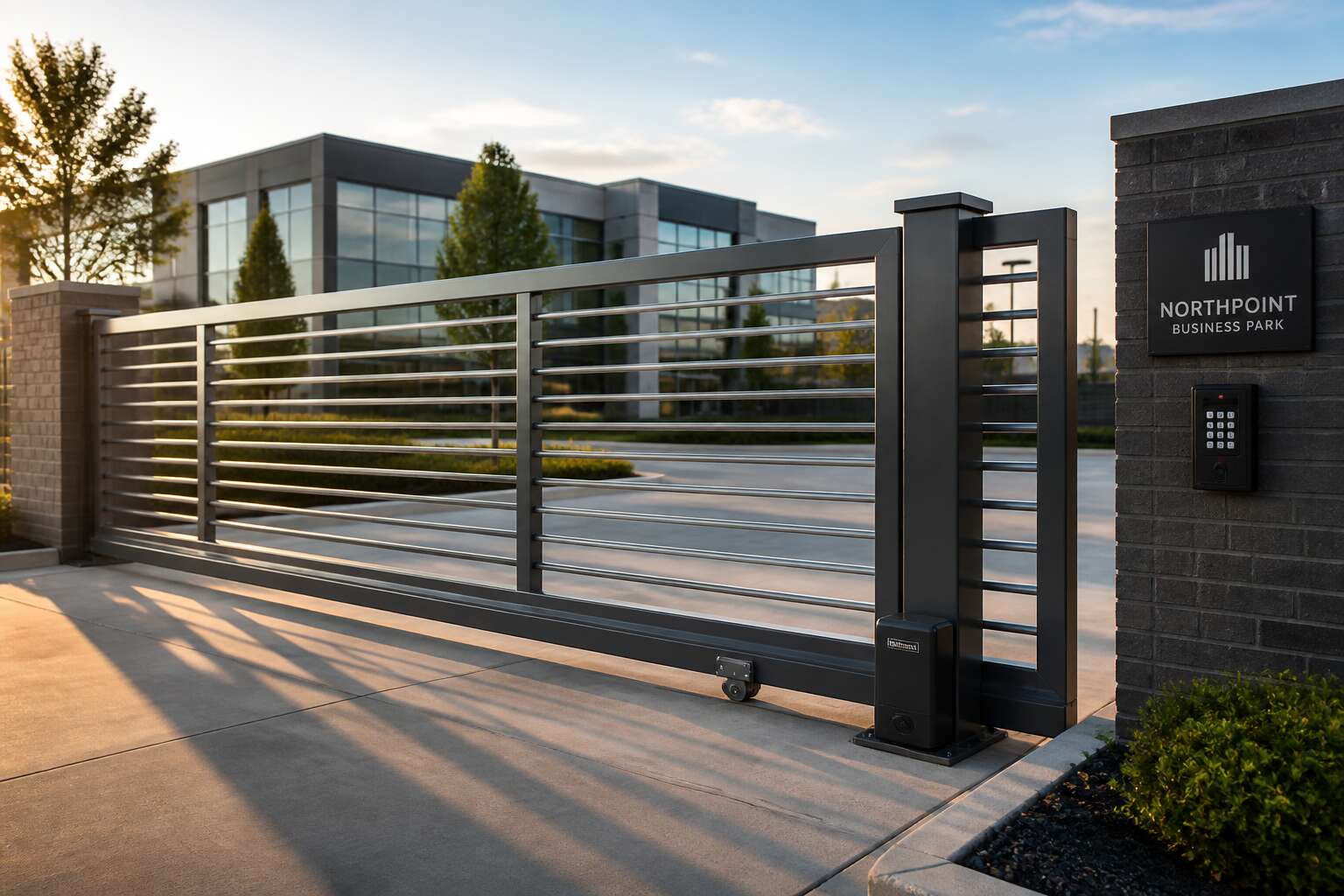
Operational Advantages for Business Premises
Enhanced Traffic Flow Management
Cape Town’s industrial districts operate on unforgiving schedules. Every minute a delivery vehicle idles at a checkpoint is a minute lost to production, payroll, and client deadlines. The physical bottleneck of a pedestrian gate simply cannot accommodate the constant flow of forklifts, bakkies, and articulated lorries. This is where the strategic deployment of sliding gates commercial offers a clear advantage, transforming a perimeter from a simple barrier into a coordinated logistics asset.
The ability to manage ingress and egress without requiring a guard to physically exit a booth is paramount. An automated sliding mechanism cycles in seconds, allowing for a continuous, seamless stream of traffic. This efficiency directly reduces fuel wastage and driver frustration. The operational process is simple:
– A vehicle approaches the sensor or intercom point.
– The gate retracts swiftly, creating a wide, unobstructed aperture.
– The vehicle passes through without stopping entirely.
– The gate closes immediately to maintain site security.
This rapid cycle is not about aesthetics; it is about throughput. For a facility handling hundreds of vehicle movements daily, the cumulative time saved is substantial. Furthermore, the design of a sliding gate, which does not require the vertical clearance of a swing gate, is ideal for sites with limited space or overhead obstacles. I have seen operations where upgrading to this system effectively erased their morning queue entirely. The result is a calmer, more orderly entrance that reflects a professionally managed business.
Space Efficiency for Tight Loading Zones
In the confined loading zones of Cape Town’s industrial properties, every square metre is contested. A swing gate consumes its own arc in clearance, forcing planners to sacrifice storage or manoeuvring room. The sliding gates commercial alternative runs flush along the fence line, claiming only a thin strip of ground. This lateral motion suits the tight geometry of existing sites.
Consider the constraints of a typical distribution yard:
– A loading bay that must accommodate reversing trucks
– A pedestrian walkway that cannot be obstructed
– A security checkpoint wedged between buildings
The sliding mechanism answers each without expanding the footprint. For premises where every square metre already carries a purpose, the value of sliding gates commercial is plain. It is the difference between a workable layout and a logistical dead end.
Durability Under Frequent Use
South African business premises do not coddle their machinery. The wind gusts, the salt air, and the honest wear of daily delivery schedules punish any weak link. One property manager in Paarden Eiland clocked over 400 open close cycles every single week. That is not a workout; that is an endurance test. A sliding gates commercial system, when specified with a decent motor and proper track, simply shrugs. It does not swing on tired hinges or need recalibration after every gust. The horizontal slide spreads pressure across the whole length. This is operational advantage in its plainest form. Frequent use becomes routine instead of a repair ticket.
Consider what holds up under repetitive strain:
- A rack and pinion drive that shrugs off grit
- A galvanised track resistant to coastal corrosion
- A brake that engages without rattling the entire fence
Choosing the Right Automated Entry System
Load Capacity and Material Strength
The burden of a sliding gate is silent until it is not. Load capacity is the first truth of an automated entrance. For sliding gates commercial use, the leaf weight dictates the motor class, the track gauge, and structural tolerance. Undersized hardware fails under repeated strain, often at an inconvenient hour. I have watched entire systems fail because someone treated the weight rating as a suggestion!
Material strength is the second truth. South Africa’s climate is unforgiving. Highveld heat, coastal salt, and downpours test every weld. Zinc-galvanised mild steel is the standard for sliding gates commercial projects. Stainless steel resists corrosion but adds cost and mass. Aluminium reduces weight but demands careful engineering to avoid flexing. The decision is a balance of physics and budget.
The key variables:
- Actual leaf mass, including infill panels
- Wind exposure and added force on the drive system
- Manual override requirements during power interruptions
Motor Type and Drive Mechanism
The motor and drive mechanism form the core decision for any automated entrance. For sliding gates commercial properties, the choice between a worm drive and a rack and pinion system determines more than just opening speed. Worm drive motors attach directly to the gear rack and manage steep inclines without strain. Rack and pinion systems deliver rapid response but require precise alignment. Hydraulic units produce substantial force, yet they increase maintenance costs. I have observed sites where the wrong motor type caused persistent operational failures, and the repair bills were brutal! For sliding gates commercial settings, the drive mechanism must suit the physical site, not the sales brochure. Consider these factors:
– Operating environment: dusty Highveld conditions shorten motor life.
– Frequency of cycles: a busy complex needs a duty rated motor.
– Power availability: loadshedding changes backup requirements.
Each factor shifts the balance between cost and reliability.
Safety Sensors and Reversing Technology
A gate that keeps closing on obstacles is a hazard, not a security feature. For sliding gates commercial, safety sensors turn raw force into controlled behaviour. Photocell beams detect obstacles before movement starts. Pressure edges stop the gate on contact. Torque sensing reverses direction when resistance spikes.
On busy sites, pedestrians and delivery vehicles share the same entrance. A reversing system that only works after contact leaves little margin. The correct setup combines non-contact detection with physical edge protection.
- Infrared beams catch a child chasing a ball.
- Pressure edges prevent pinching accidents.
- Torque sensing stops the gate if something jams.
I have seen sites where sensors were disabled due to false triggers. Those sites usually faced liability claims soon after. Clean lenses and a monthly test cost less than a settlement.
Smart Access Control Integration
Choosing the right automated entry system is an exercise in foresight, not just a matter of picking the most powerful motor. A sliding gates commercial installation demands a control solution that matches the daily rhythm of your site. A facility expecting high volumes of deliveries requires different logic than a private depot with sporadic traffic. You need to consider how the gate interacts with existing security protocols, from intercom systems to vehicle detection loops, before committing to a specific controller.
Smart access control integration transforms the gate from a passive barrier into a proactive element of your security architecture. Modern systems allow for mobile credentialing, where authorised personnel gain entry via a smartphone app instead of a physical remote. This eliminates the risk of lost or cloned transmitters. For businesses managing multiple locations, centralised cloud management offers real-time visibility into gate activity across all sites, providing a granular audit trail that manual logs simply cannot match.
– Mobile token authentication reduces the need for physical key management.
– Biometric readers can be integrated for high-security zones within the same entry point.
– Automatic number plate recognition streamlines regular vehicle access.
– Geofencing capabilities can pre-authorise entry based on location.
The selection process should question how the gate’s brain operates under pressure. Will it integrate smoothly with your building management system, or is it a closed ecosystem? Consider the power source and the provision for battery backup, as a gate that fails during a power outage creates a security void. Look for systems that offer remote diagnostics, allowing technicians to identify and resolve faults before you even notice a disruption in service.
These decisions shape the user experience. A well-integrated system allows for seamless traffic flow, where vehicles approach and gain access without unnecessary stopping. This operational fluidity reduces congestion at the entry point and improves the overall efficiency of your logistics. The goal is an automated environment that works discreetly in the background, engineered to manage complex access demands with minimal friction and maximum accountability.
Professional Installation and Site Preparation
Ground Conditions and Foundation Requirements
Roughly a third of Gauteng’s surface sits on dolomite, a rock formation where unseen voids can compromise anything built above it. A sliding gates commercial installation demands a foundation matched to this geology. Professional installers begin with a site survey, testing compaction and drainage before any concrete is poured.
The foundation carries the entire weight and motion of the gate. Rebar-reinforced concrete pads, typically 600mm deep, suit most conditions. For unstable ground, deeper footings and additional steel become necessary.
Site preparation should account for:
- Underground services like water pipes and electrical cables
- Stormwater runoff patterns that could erode the track bed
- The gate’s travel path, ensuring a clear, level sweep
Without this groundwork, even the finest mechanism will struggle against shifting ground. It’s a lesson I’ve seen repeated too often on site!
Electrical and Wiring Considerations
The electrics of a sliding gates commercial system are its nervous system. In Gauteng’s thunderstorm season, one lightning-induced spike can fry the control board, leaving the gate frozen and trucks queued at the loading bay. Surge protection is not optional; it is insurance you cannot skip.
Wiring deserves the same scrutiny as the mechanics. Armoured cables, properly earthed, reduce interference and prevent nuisance tripping. The motor needs a dedicated circuit, never a shared line with compressors or welding equipment that draw heavy current. Even a robust sliding gates commercial installation will fail if its power source is unreliable.
Critical electrical decisions include:
- Cable sizing for voltage drop over long runs
- Backup battery capacity for load shedding
- Emergency release mechanisms for manual operation
- Ingress protection ratings for outdoor components
These choices dictate whether the gate remains operational when the grid falters.
Compliance with Local Building Codes
Every sliding gates commercial installation begins long before the motor hums to life. It starts with the site itself, a canvas of concrete, soil, and subterranean services. The foundation is an architectural act, not an afterthought. A gate is a moving sculpture, and its stage must be level, true, and ready.
Compliance with local building codes is not a bureaucratic hurdle; it is a blueprint for longevity. In South Africa, municipalities enforce regulations that dictate setback lines, boundary walls, and structural integrity. These rules exist to protect both the property owner and the public. Ignoring them can result in costly fines, forced removal, or liability for accidents. A reputable installer understands the local by-laws and helps navigate the approval process. They ensure the necessary permissions are in place before a single trench is dug.
Site preparation also involves a careful assessment of the terrain. The installation team should conduct a site survey to identify potential obstacles. Underground cables, water pipes, and drainage channels can all complicate the excavation process. A professional team will plan the foundation to avoid disrupting these services. They will also assess the soil type, as shifting sands or expansive clay require different foundation depths.
– Verify the boundary line survey to confirm the exact property limits.
– Confirm that the gate’s travel path does not encroach on municipal property.
– Ensure the foundation design accounts for the specific soil conditions on your site.
The concrete foundation for a sliding gates commercial system is its anchor to the earth. It must be reinforced with steel rebar and cured properly to prevent cracking under constant stress. The track and roller bearings depend on a perfectly level surface for smooth operation. Any deviation, even a few millimetres, will translate into premature wear on the motor and gears. This preparation phase is the quiet, diligent work that prevents future chaos.
Finally, consider the electrical connections from the municipality. The installation site needs a stable power supply point that is easily accessible to the gate motor. Coordination with the local utility may be required to pull a new service line, a process that can take weeks. Planning for this in advance avoids project delays and ensures the entire system, from the concrete footings to the control board, is built on solid ground. The magic of a seamless gate lies in the invisible, meticulous work of its preparation.
Testing and Calibration Protocols
The real test begins after the concrete cures. A professional installation crew will run the sliding gates commercial system through a series of calibration protocols before handing over the keys. The limit switches need precise adjustment so the gate stops exactly where it should, every time. The motor torque must be tuned to match the gate’s weight, preventing strain on the gears.
Site preparation testing also covers the track bed. A laser level verifies the foundation is true to within a few millimetres. From there, the crew works through a set sequence:
- The gate is rolled manually to check for friction points.
- The motor is engaged at low speed to observe the travel path.
- Safety sensors are triggered to confirm automatic reversal.
- The final speed and soft-stop settings are programmed.
Each step is logged and signed off. This calibration phase is where minor issues get caught in any sliding gates commercial installation, not after months of use.
Long-Term Maintenance and Reliability
Routine Inspection Checklist
South Africa’s coastal climate is unforgiving. Salt-laden air accelerates corrosion on sliding gates commercial installations, which is why a routine inspection checklist is essential. I have seen operators extend gate life by years through simple, consistent checks.
The checklist should cover the following:
- Track alignment and debris accumulation
- Roller bearing wear and lubrication points
- Gate sag or drag against the concrete apron
These items reveal developing problems before they become costly failures. Catching a misaligned track early prevents motor strain and unplanned downtime. Reliability is built through repetition, not last-minute fixes. A scheduled inspection, performed monthly, transforms a sliding gates commercial system into a dependable asset.
Lubrication and Component Wear
Heading south along the coast, the ocean breeze deposits a fine, abrasive film on every exposed surface. For a sliding gates commercial system, this airborne grit mingles with the grease, transforming a protective layer into a grinding paste. The sound of metal on metal is the first whisper of trouble, a dry screech that carries across a warehouse yard long before the motor begins to strain.
Lubrication is not a single event, but a discipline. The schedule must align with the environment, not the calendar alone. A gate used heavily under a coastal sun demands attention far more often than one tucked inland behind a quiet office park. When you open the gearbox and find the lubricant turned to a dark, gritty sludge, you are looking at accelerated wear. This is where component degradation becomes a matter of arithmetic: every gram of lost material reduces the tolerance between gears and bearings, inviting play and backlash.
Regular attention to the moving parts, the rollers and the drive chain, prevents the slow erosion of the mechanism’s integrity.
– Check the drive sprocket for worn tooth profiles, a sign of misalignment or lack of lubrication.
– Examine the rollers for flat spots or a dull sheen, indicating surface fatigue from constant load.
– Listen for a chattering or thumping motor, a rhythm that suggests a stretched belt or a failing bearing.
Metal fatigue in this context rarely explodes into failure. It whispers through a wobble in the gate’s travel, a slight hesitation on startup, or a visible film of metal dust on the track. By addressing these symptoms, you turn the daily grind of a sliding gates commercial operation into a predictable schedule, where the lifespan of a component is measured in years, not sudden breaks. The goal is to manage the wear, keeping the metal quiet and the mechanism fluid, so the gate opens with the same confidence on a dusty Tuesday as it does after a Monday night downpour. Consistency in maintenance is the true anchor of reliability.
Troubleshooting Common Operational Issues
In the South African climate, the real test for any sliding gates commercial system rarely lies in the initial installation. It lives in the years of relentless sun, brownouts, and sudden downpours that expose hidden operational flaws.
The most neglected troublemaker is the gate’s travel path. A few millimetres of ground shift or a worn wheel bearing causes the gate to lean, straining the motor. Troubleshooting demands assessing the track level against the concrete, not just the gate itself.
When an issue arises, a strict diagnostic sequence prevents wasted downtime:
- Measure the voltage at the motor terminals to catch brownout failures.
- Test the limit switch with a multimeter, as magnet buildup prevents clean stops.
- Inspect the emergency release tension, as rust seizes the mechanism.
Reliability comes from addressing these faults before a complete lockout. A sliding gates commercial unit operating daily across a Highveld winter needs a proactive mindset. The subtle indicators are current spikes, seen only on a clamp meter. Ignoring them invites costly failures. Overhauling specific assemblies extends the asset’s usable life. A disciplined owner who tracks operational quirks converts unpredictable breakdowns into manageable housekeeping.
Scheduling Preventive Service Visits
A fixed service calendar turns scattered repairs into a predictable rhythm. For any sliding gates commercial installation, the quarterly visit matters more than the annual overhaul. A technician arrives with the unit’s history, checks the travel path for subtle deflection, and measures the motor’s current draw against last season’s baseline.
That routine uncovers quiet failures early.
- Verify the rack and pinion backlash.
- Inspect the emergency release for seized pivots.
- Log all readings for trend comparison.
Each visit adds depth to the system’s memory. Over time, the maintenance record exposes patterns tied to the site’s specific exposure, like coastal corrosion or dust loading. An owner who keeps these appointments avoids the costly surprise of a complete lockout mid-week.
Financial Considerations for Facility Managers
Initial Investment vs. Long-Term Savings
The decision to install sliding gates commercial is often framed as a simple cost question, but the true ledger is written in decades, not days. South African facility managers face a persistent tension between the immediate strain on capital budgets and the quiet, cumulative drain of operational expenses. A cheaper gate system may appear attractive during procurement, yet its maintenance schedule and energy consumption often rewrite the initial savings into long term liabilities. The comparative analysis must therefore extend beyond the purchase price to the total cost of ownership.
When evaluating options, facility managers should weigh specific factors that directly impact their annual financial statements.
– Initial purchase price and installation complexity
– Expected lifespan of the motor and structural components
– Frequency and cost of required maintenance interventions
– Energy efficiency ratings of the drive mechanism
– Replacement part availability within the local South African market
The interplay between these variables determines whether the gate becomes an asset or a recurring expense. For instance, a robust motor with a higher upfront cost may consume less power and require fewer service calls, which in turn reduces the total expenditure over a five year period. Conversely, opting for the lowest tender price often introduces hidden costs, such as premature wear on rollers or electronic failures during load shedding events. These interruptions not only incur repair bills but also disrupt operational flow, a cost that rarely appears on an invoice. The prudent approach is to model both scenarios using realistic local data, accounting for the specific demands of your site and the frequency of use. This calculation will reveal that the true financial efficiency of sliding gates commercial lies in the balance between what you pay today and what you avoid paying tomorrow.
Energy Efficiency of Modern Motors
Electricity tariffs in South Africa have climbed steadily for years, and the motor that drives a gate runs every single day. That reality turns energy efficiency into a direct line item on your operational budget. A motor that draws less power while maintaining consistent torque reduces the monthly load without sacrificing performance. For sliding gates commercial, this distinction matters most during high traffic periods when the mechanism cycles dozens of times per shift.
The drive mechanism determines how much energy translates into motion and how much dissipates as heat. Modern AC motors with variable frequency drives adjust their speed and power output to match the actual resistance of the gate panel. Older fixed speed units run at full capacity regardless of conditions, wasting electricity on every cycle. During extended outages, a battery backup paired with an efficient motor keeps the gate operational for more cycles, preserving security and access when the grid falters.
Consider the specifications that influence long term consumption:
– Power draw at idle versus under load
– Standby power consumption when the gate is stationary
– Efficiency rating of the gearbox and drive train
– Compatibility with solar or hybrid power configurations
A facility that processes hundreds of vehicles per day will see meaningful kilowatt hour differences between motor types. Over a year, those kilowatts translate into rands that never appear on a purchase order but always show up on the municipal invoice. An efficient system also generates less heat, which reduces strain on surrounding electrical components and extends their service life. The quiet hum of a well tuned motor signals prudent long term planning for any sliding gates commercial installation.
Warranty and After-Sales Support
Warranty terms expose the true character of a sliding gates commercial supplier. A standard twelve month guarantee might sound sufficient, but the fine print often reveals exclusions for wear items, environmental damage, or specific usage patterns. Facility managers should scrutinise what the warranty actually covers, not just how long it lasts. Motors, control boards, gearboxes, and safety sensors each carry different failure profiles. A warranty that lumps them together obscures more than it clarifies.
After-sales support is the difference between a minor interruption and a costly shutdown. When a gate fails at a busy entrance, the response time of a technician becomes the most important metric in your operation. Consider these factors before signing any purchase agreement:
1. Response time guaranteed in the service contract
2. Availability of spare parts within the local market
3. Technician certification and familiarity with your specific model
4. Remote diagnostic capability for rapid problem identification
Facilities in South Africa often operate far from major urban centres where suppliers maintain stock. A sliding gates commercial system that relies on imported components can remain inoperative for weeks while parts clear customs. Local support infrastructure determines whether your gate returns to service in hours or in months. The cheapest quotation rarely includes this calculation. Facility managers who evaluate the full cost of ownership, including downtime and repair expenses, make decisions that serve their operations for years rather than until the first breakdown.
Potential Insurance Premium Reductions
Some insurers quietly reward properties that demonstrate reduced liability exposure. A sliding gates commercial installation, when paired with verified safety features, can shift your risk profile in measurable ways. Underwriters examine the mechanics of entry control, not just its visual presence.
Consider what they evaluate during a premium assessment:
- Integration with existing access control systems
- Certification of safety sensors and reversing mechanisms
- Documented maintenance records from qualified technicians
A gate that fails or operates erratically invites claims. A reliable system, however, signals disciplined oversight. South African facilities that invest accordingly often negotiate better terms.
Lifecycle Cost Analysis
Most facility managers misjudge the true cost of their entry system within the first year of operation. A sliding gates commercial installation demands a lifecycle perspective that extends well beyond the purchase order.
Lifecycle cost analysis forces you to account for every rand spent from procurement to decommissioning. This includes periodic motor replacement, structural refinishing, and control board upgrades. When I review facility budgets, I often find that maintenance labour outweighs parts by a three to one ratio. This is where most lifecycle projections go wrong!
Build your model around these variables:
- Expected service life of the gate structure and motor assembly
- Preventive maintenance intervals dictated by usage cycles
- Escalation rates for specialised labour in your region
Facilities that capture this data accurately often discover that the most economical sliding gates commercial systems feature modular components. This allows targeted replacement without full unit dismantling, reducing long term expenditure significantly.



0 Comments