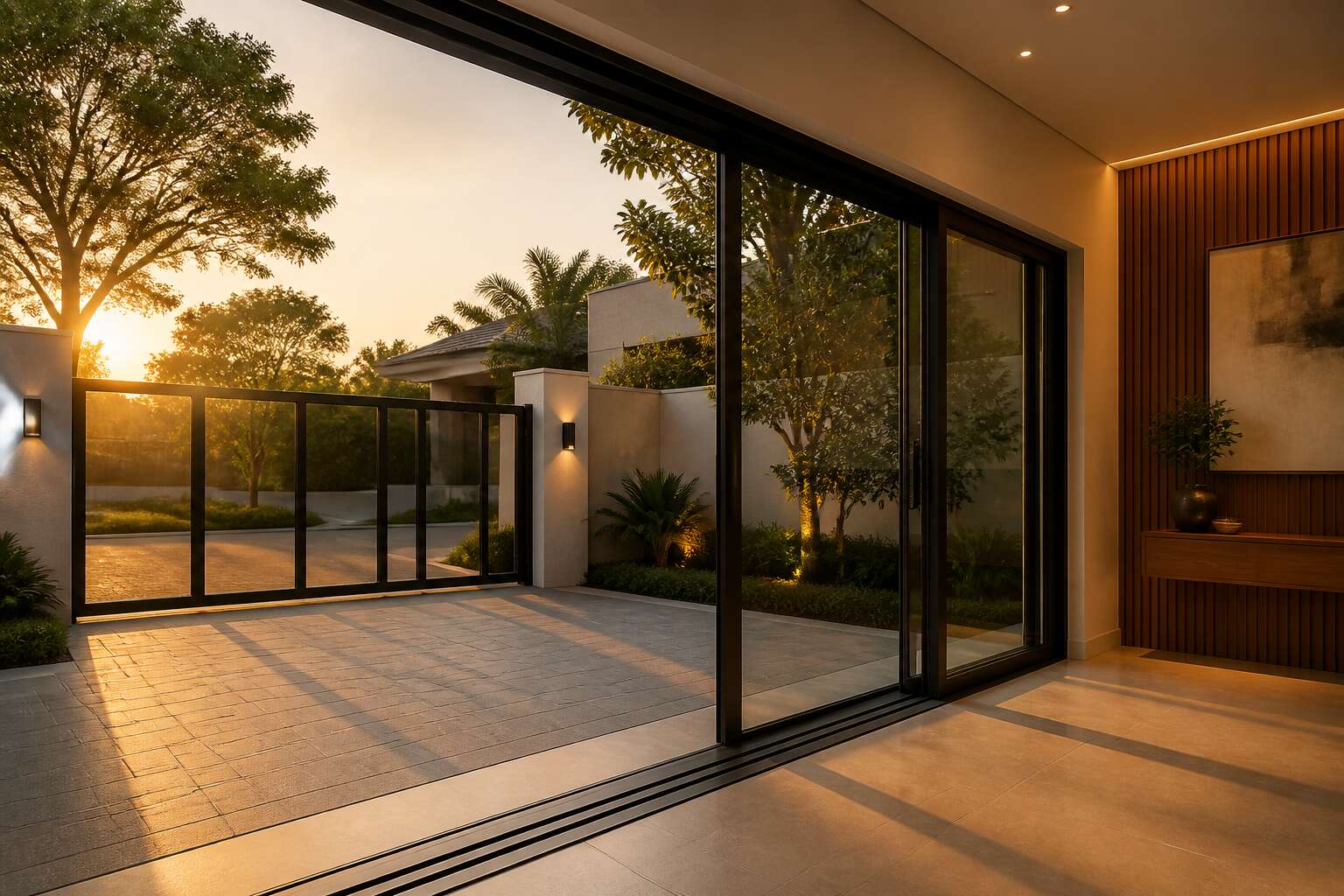
Understanding Sliding Gate Mechanisms
How Sliding Gates Operate vs. Swing Gates
Automation has shifted the default for secure entry points. Door sliding gates operate on a horizontal plane, using either a bottom track or a cantilever system that lifts the weight off the ground. This changes the spatial requirement. Swing gates demand a radius of empty space to complete their arc. A sliding alternative needs only enough width for the gate leaf to travel. For narrow driveways common in South African suburbs, that difference decides everything.
The operating logic differs in speed and safety. Door sliding gates move along a fixed line, reducing the risk of striking a car or pedestrian. Swing gates open outward or inward, so obstacles in the path halt them.
Motor requirements differ. Sliding gates use a rack and pinion drive. Swing gates couple to the hinge post, placing stress on the hinges. Understanding these mechanisms reveals whether a retrofit is feasible, or whether the site demands a custom build.
Key Components of a Sliding Gate System
The average sliding gate is a study in controlled violence. A motor must summon enough force to move hundreds of kilograms of steel, yet possess the finesse to stop on a precise point without shearing the gears. This contradiction is the heart of the engineering. The motor drives a pinion gear, which engages with the perforated steel strap bolted to the gate, known as the rack. This interaction is the fundamental relationship here. The motor mounts to a plinth, usually of reinforced concrete, while the gate glides on a wheeled carrier. These carriers are not universal, they are load-rated components. A gate for a residential property, with its thinner sheeting and lighter frame, will have different requirements than a solid steel industrial version designed to block wind and intrusion.
The secret to a smooth operation lies in the suspension system. There are two primary types. The first uses a bottom track, which is recessed into the driveway. The second, the cantilever system, uses wheels that grip the top and bottom of a special beam, effectively suspending the gate.
For door sliding gates, the debate often comes down to these options:
- Bottom track systems are simpler to install but are vulnerable to dirt and debris accumulation.
- Cantilever designs have a higher initial cost but require zero ground clearance and are ideal for sloped driveways.-li>
For situations where the water table is high, lifting the gate off the ground is not just about function. It is about preventing the theft of the gate itself.
The wheel bearings take the weight, but the adjustable wheels at the back of the post bear the vertical load. This prevents the gate from swaying and keeps the actual leaf stable.
Common Types of Sliding Gate Tracks and Rollers
The difference between a gate’s longevity and its eventual groan of failure often lies beneath the steel, in the humble roller. I have watched hardened bearings fail within a year simply because the soil around the track became a sponge during a Highveld thunderstorm. Your door sliding gates in South Africa face a unique tyranny: heat, grit, and relentless UV exposure. The most common mechanism remains the single bottom track, a simple channel anchored into concrete that guides a bogie on steel wheels. The alternative, the cantilever track, avoids ground contact entirely by clamping the gate’s beam between vertical rollers.
- Single track requires precise concrete leveling.
- Cantilever uses a fabricated beam, excellent over crushed stone drives.
Each type demands a careful analysis of your actual site drainage. Ignore this at your own risk, for water loves a recessed channel.
Key Benefits of Automated Sliding Gates
Space Efficiency and Property Access
In South Africa, a swing gate can waste a four square metre arc every time it opens. On narrow plots, those square metres are scarce. Door sliding gates move sideways along a rail, leaving the entire driveway width untouched for vehicles and pedestrians.
The automation adds real convenience for door sliding gates, particularly for property access. You can open the gate from inside the house, so visitors wait seconds instead of minutes during load-shedding. The lack of a swinging arc means cars park closer to the boundary, cutting walking distance on rainy days. Emergency responders also find a clear path immediately.
- No wasted space for gate swing circumference
- Quicker entry without exiting your vehicle
- Better use of narrow driveways on sloped plots
Enhanced Security and Access Control
Automated door sliding gates turn a simple entrance into a controlled threshold. The motorised mechanism locks firmly after every cycle, removing the small gaps that manual latches tend to leave behind. You gain a hard boundary that responds only to your commands, not to chance or forgetfulness.
Access control becomes precise. You can issue temporary codes to a gardener, grant time restricted entry to deliveries, and receive an alert when the gate activates after dark. The system records each opening, creating a practical audit trail for estate managers.
Security layers stack cleanly:
- Intercom verification confirms identity before the gate moves
- Auto reverse sensors prevent forced entries during closing
- Remote monitoring shows gate status from your phone
Each element works with the next, meaning entry happens only when you allow it.
Convenience Through Remote and Smart Operation
On a typical Johannesburg estate, residents collectively spend over 200 hours each year physically moving their gates. That figure explains the quiet shift toward smart control. Modern door sliding gates now respond to a smartphone before you even reach the driveway.
Imagine receiving an alert that your gate is standing open, then closing it from the office. That is the practical reality of integrated operation. You can schedule automatic opening for the morning school run, or grant a neighbour temporary access while you are away.
Consider what remote convenience eliminates:
- The scramble for keys during load shedding
- The awkward reverse when visitors arrive unexpectedly
- The nagging doubt about whether you locked up
Each small friction disappears. The gate reads your routine and responds accordingly, which is precisely why door sliding gates have become the preferred entrance solution for busy households.
Durability and Long-Term Cost Savings
Homeowners in Johannesburg are starting to see the real financial picture of their property access. It isn’t just about the initial purchase price anymore. The true cost emerges over years of maintenance, repairs, and energy consumption. When you consider the frequent issues with manual gates, from misaligned wheels to stripped gears, the long-term expenses add up quickly. This is where the conversation shifts toward automated door sliding gates, a solution designed to reduce those ongoing costs while increasing the value of your property.
The durability of a well-constructed sliding gate is a direct response to the demanding South African climate and security landscape. Unlike swinging alternatives that rely on heavy hinges which can sag over time, a sliding mechanism distributes weight evenly across a track and guide rollers. This reduces stress on individual components. Consequently, you face fewer breakdowns and less frequent replacement of parts. Investing in a high-quality electric motor and corrosion-resistant materials means your system withstands daily use and harsh weather without the constant need for a technician.
The long-term cost savings are compelling when you break them down. Consider the expenses you sidestep with a robust system:
– Elimination of frequent call-out fees for manual gate repairs.
– Reduced wear and tear on your vehicle from stopping to open the gate manually.
– Lower insurance premiums, as security features like auto-close and remote monitoring often qualify for discounts.
– Increased property resale value due to the installed convenience and security infrastructure.
The true financial benefit lies in the prevention of emergency replacements. A motor that runs smoothly on a well-maintained track uses less electricity and lasts longer. This dependable operation also extends to the safety beams and internal gearing, which are protected from the elements. For a Johannesburg property, where security is a primary concern, a reliable gate that functions every time offers peace of mind that is difficult to price. Yet, the savings on unexpected expenses are a tangible benefit you can track.
Choosing the right system involves looking past the sticker price. You are paying for engineering that handles frequent use. High-cycle motors, galvanized tracks, and sealed bearings are not luxury additions; they are essentials for longevity. When you install a system built for the long haul, you are making a clear financial decision. It transforms a simple entry point into a durable asset. The result is a secure entrance that performs consistently, saving you money and hassle for many years.
Materials and Design Options
Choosing Between Steel, Aluminum, and Wrought Iron
Steel remains the stalwart choice for door sliding gates in South Africa, offering formidable resistance to force. Its weight demands a robust track and motor, which owners of older driveways often underestimate.
Aluminum is the lightweight contender. It never rusts, a boon for coastal properties from Durban to the Cape. The trade-off is a reduction in sheer strength, so it suits perimeter aesthetics over primary security.
Wrought iron carries the finest visual pedigree, with scrollwork suggesting a bygone era of craftsmanship. It requires vigilant maintenance, as any chipped paint becomes a rust site within weeks.
- Steel suits high-security compounds and industrial settings.
- Aluminum fits modern architectural lines and salty air.
- Wrought iron complements period homes and heritage estates.
The design language should mirror your property’s character. A minimalist aluminum frame looks absurd on a Cape Dutch homestead, while heavy steel grilles overwhelm a sleek glass façade. Your door sliding gates are the most visible element of your entry point, so choose a material that reflects your standards without shouting.
Style Variations: From Minimalist to Ornate
A property’s entrance sets the tone for everything beyond it. With door sliding gates, that first impression hinges on a choice between clean architectural lines and the kind of ornamental detail that stops passersby in their tracks. The material you select often dictates which of these paths is available. Aluminium’s inherent strength with a slim profile makes it the perfect canvas for a minimalist look, particularly when paired with horizontal slats or a simple, powder-coated finish in a tone like charcoal or bronze. These designs let the gate recede into the landscaping, creating an understated elegance that speaks to modern sensibilities.
On the opposite end of the spectrum, decorative styles allow for a more expressive statement. Steel’s malleability means it can be fashioned into intricate scrollwork, geometric lattice patterns, or even custom motifs that echo the architecture of the main house. This is where a gate becomes a piece of functional art.
Here’s a quick look at how different approaches translate across the most popular materials:
– Horizontal slat overlays on a steel frame offer a contemporary look with a touch of privacy.
– Spear-top finials and twisted bars deliver a classic, secure aesthetic that pairs well with brick pillars.
– Perforated aluminium sheets provide a modern, semi-private screen that plays with light and shadow beautifully.
– Reeded or grooved profiles in aluminium add texture and depth without venturing into the ornate.
For those drawn to a livelier visual rhythm, mixing materials is a clever strategy. A robust steel frame for structure, combined with timber or composite infill panels, introduces warmth that contrasts nicely with cold metal. You might also see glass reinforced with steel mesh, which maintains visibility while adding a layer of security and a distinctly contemporary character. The key is to ensure the style complements the home’s existing language; a sleek, handle-less design will feel out of place on a rustic farmhouse, just as a heavily ornamented gate can clash with a stark, cubic home.
Ultimately, the design journey is about matching the gate’s visual weight to its surroundings. Consider how the gate will look from both inside and outside the property, and how it interacts with the drive, the lighting, and the neighbouring fences. When the style, material, and function align, the result feels less like a barrier and more like a natural extension of the home’s personality.
Incorporating Glass, Wood, or Composite Panels
The panel inside a sliding gate does more than fill space. It shapes how you feel each time you arrive home. For door sliding gates in South Africa, the material choice between glass, wood, or composite determines the daily experience of light, privacy, and upkeep.
Here is what each panel demands:
- Tempered glass offers transparency but collects salt spray near the coast.
- Hardwood like balau adds warmth yet needs regular sealing against moisture.
- Composite mimics wood while resisting rot and insects.
The frame must handle the panel’s weight. A timber infill strains the rollers and motor. Glass reduces that load but removes privacy. Composite balances both, though its colour fades under harsh UV. The right material aligns with your climate and your daily routine.
Custom Paint, Powder Coating, and Finishes
Choosing the right finish for your door sliding gates is just as important as the structural material. In South Africa, the climate varies from humid coastal air to dry, highveld sun, and each environment tests different coatings in unique ways. A high-quality powder coating remains the industry standard for a reason. It offers a tough, uniform layer that resists chipping and scratching far better than conventional paint. For properties near the ocean, this is not a luxury but a necessity, as salt spray can quickly degrade inferior surfaces.
Beyond simple protection, the finish defines the visual tone of the property. Custom paint options allow you to match the gate to your architectural palette precisely, but they require meticulous surface preparation and a skilled applicator. Powder coating, on the other hand, provides a more consistent texture and is available in a wider range of metallic and matte finishes. The choice often comes down to whether you prioritize the exact colour matching of wet paint or the superior durability and low maintenance of a baked-on powder finish.
For added protection, many homeowners are turning to specialised treatments embedded in the powder itself. Anti-corrosion primers are essential for mild steel, while aluminium frames benefit from a clear anodized seal. Even the grit size of the finish can be tailored; a textured surface hides minor blemishes and fingerprints, making it ideal for busy households. The longevity of your investment hinges on these details. A robust finish means the difference between a gate that still looks immaculate after five years and one that requires a full strip-down and repaint. Ultimately, the best choice for your door sliding gates balances aesthetic appeal with the specific environmental pressures your property faces.
Integrating Lighting and Decorative Elements
As dusk settles over a Johannesburg suburb or a Cape Town coastal road, the true character of a property often reveals itself through its entrance. A door sliding gate, during the day, presents a robust facade of steel or aluminium. Yet, as the light fades, its design language shifts entirely. The interplay of illumination and structural form transforms a utilitarian security fixture into a nuanced architectural feature.
Lighting, in this context, is a tool for sculpting. When positioned correctly, it can highlight the vertical lines of a slatted design or cast dramatic shadows through geometric cutouts. This is where the selection of decorative elements becomes a practical decision. Consider these interior options that merge atmosphere with function:
– Recessed LED strips embedded in the gate posts provide a clean, indirect glow that washes over the track and wheels.
– Uplighting placed at the base of the frame draws the eye upward, emphasising the gate’s height and solid construction.
– Backlit panels made of polycarbonate can turn the gate into a soft lantern at night, offering privacy while broadcasting a warm welcome.
The vertical space of a sliding gate also presents an opportunity to integrate natural textures. A horizontal timber slat insert, fixed to the metal frame, can soften the industrial aesthetic. This organic element interacts with the evening light differently than metal, offering a tactile contrast that is both striking and functional. However, for those who prefer a uniform look, powder-coated mesh panels in darker shades tend to recede visually, making the surrounding landscaping the primary focus. The goal is to ensure the hardware serves the architecture, not the other way around. By thoughtfully integrating these design and lighting choices, your door sliding gates can become a seamless extension of your home’s style and a sophisticated layer of its security posture.
Installation and Maintenance Considerations
Site Preparation and Foundation Requirements
A sliding gate’s longevity begins beneath the soil line. We often focus on visible machinery, but the concrete foundation and its reinforcing steel carry the entire system’s burden. For South African conditions, expansive soils demand careful excavation to a stable depth. Properly compacted subgrade and a cured concrete haunch prevent later misalignment.
Consider these sequence requirements for site preparation:
- Verify underground utilities before any excavation
- Establish a level reference line along the full travel path
- Set foundation dimensions according to gate weight, not just gate width
Ongoing maintenance becomes simpler with this groundwork. For door sliding gates, routine checks of the track bed and drainage channels will prevent debris accumulation from compromising movement. I always advise annual inspection of the foundation’s perimeter for erosion or cracking, as small fissures quickly become alignment problems.
Professional Installation vs. DIY Kits
A sliding gate is a machine as much as a structure. The difference between professional installation and a DIY kit appears within the first year of operation. Professional teams arrive with laser alignment tools and torque specifications. They understand local soil behaviour and wind loads. DIY kits transfer that risk to the homeowner.
A kit includes the gate panel, track, rollers, and motor. What it lacks is site-specific engineering. For door sliding gates, motor limit switch calibration alone demands precision.
What separates a good installation from a problematic one:
- Gate drop testing under full wind load
- Emergency release verification
- Photoelectric sensor alignment
DIY installation can work for lightweight gates on level ground. Automated door sliding gates demand more. Electrical connections, safety edges, and receiver placement factor into the result. Maintenance obligations differ. Professionals document service intervals and leave wiring diagrams. DIY owners learn through trial and error.
Routine Maintenance for Tracks, Motors, and Sensors
Installation and Maintenance Considerations
A sliding gate represents a significant investment in your property’s security and curb appeal. Proper installation and consistent maintenance are not optional luxuries; they are the pillars that ensure your gate operates safely and reliably for decades. South African weather, with its intense sun and seasonal rains, demands materials and workmanship that can withstand harsh conditions. The difference between a gate that glides effortlessly for years and one that grinds to a halt within months often comes down to the quality of the initial installation and the discipline of a regular care routine.
The installation process begins long before the concrete is poured. A professional team will first conduct a thorough site survey to assess the terrain’s slope and drainage. This step is critical because a foundation that shifts or retains water will cause the gate’s frame to rack, leading to wheels jumping the track and misaligned safety sensors. The concrete footing must be deep enough to anchor the posts securely, preventing them from leaning under the gate’s constant weight and movement. Furthermore, the electrical supply for the motor and access control systems must be installed by a certified electrician, ensuring compliance with local regulations and protecting your family from electrical hazards.
Once the physical installation is complete, the real work of tuning the system begins. This is where expertise separates a seamless operation from a persistent headache. The motor’s limit switches, which tell the gate when to stop in the open and closed positions, must be calibrated with precision. If set incorrectly, the motor will strain against the mechanical stops, causing premature wear on the gearbox and reducing the lifespan of the entire unit. Similarly, the gate’s open and close speeds and the force sensitivity must be adjusted. An overly sensitive gate will reverse on a gust of wind, while one that is not sensitive enough becomes a safety hazard, failing to stop if it contacts a person or vehicle.
The golden rule of any automatic gate is that the safety devices are the most critical components. Photoelectric sensors, which detect obstructions in the gate’s path, should be installed at a height that a child or small animal cannot crawl under. These sensors must be tested monthly to ensure they are clean and properly aligned, as a dusty lens can create a “ghost” obstruction or, conversely, fail to register a solid object. The manual release mechanism, usually a key or lever that disengages the motor for manual operation during a power outage, must be checked regularly to prevent it from seizing up. Homeowners should familiarise themselves with this release system, as it is essential for emergency egress.
Regular maintenance tasks are straightforward but require consistency. Here is a concise checklist to guide your routine:
– Lubricate the Track and Rollers: Apply a lithium-based grease to the track surface, roller bearings, and hinges every three months. This prevents rust and reduces friction, allowing the motor to work less.
– Inspect for Loose Hardware: Vibration can loosen bolts and nuts over time. A quarterly inspection of the gate’s frame, bracket fixings, and motor mounts can prevent dangerous sway and premature failure.
– Clean the Photoelectric Sensors: Wipe the sensor lenses with a soft, dry cloth once a month to ensure they function without interruption.
– Test the Auto-Reverse Feature: Place a solid object, like a cardboard box, in the gate’s path and close it. The gate should stop and reverse upon contact. If it does not, discontinue use and call a professional immediately.
For maintenance on your door sliding gates, pay particular attention to the bottom track. Dirt, stones, and leaves can accumulate in this channel, acting as sandpaper on the wheels and causing the gate to run unevenly. A quick sweep of the track with a stiff broom every week will significantly extend the life of your rollers. In coastal regions, where salt-laden air accelerates corrosion, wiping down the metal components with a damp cloth more frequently will help stave off rust.
While DIY maintenance on your door sliding gates is encouraged for basic tasks, the motor unit and electrical components should always be handled by qualified technicians. Attempting to repair a malfunctioning control board or motor without the proper training can lead to serious injury and will likely void your warranty. Having a professional service your gate annually will not only catch minor issues before they become costly repairs but will also provide you with the peace of mind that your gate is operating at peak safety and performance standards. This proactive approach ensures that your access point remains a secure and smooth entry point to your home, providing convenience without compromise.
Troubleshooting Common Sliding Gate Issues
Few things frustrate a homeowner more than a door sliding gates system that refuses to cooperate for no obvious reason. A gate that opens only halfway during mid-afternoon often points to a photoelectric sensor being momentarily blinded by a stray reflection from the sun. This is a frequent occurrence on east-facing installations in Gauteng, where the winter sun angles directly into the lenses.
Mechanical noises from door sliding gates, on the other hand, deserve immediate attention. A high-pitched screech from the rollers signifies a seized bearing, while a deep rumble usually indicates that the chain drive has lost its tension. Ground movement is another consideration; shifting clay soils can cause the bottom track to settle, creating a slope that makes the gate work harder to move.
Safety Features and Compliance
Essential Safety Sensors and Auto-Reverse Mechanisms
Every year, costly property damage and personal injury occur because a basic sliding gate lacks modern safeguards. A graceful, automated entrance is only as good as its protective technologies. When you select door sliding gates for your South African property, you inherit a responsibility to ensure they operate without endangering people, pets, or vehicles. This is where photoelectric sensors become indispensable. These devices project an invisible beam across the gateway; the moment a child or a delivery courier crosses this threshold, the motor halts entirely, freezing the heavy panel in its tracks before momentum creates a hazard.
Beyond the beam lie pressure-sensitive edges. These rubberized strips act as the gate’s nerve endings, detecting even the slightest physical resistance. Should the panel nudge a stray branch or a car bumper, the system reverses direction immediately. This auto-reverse mechanism is not a luxury but a legal necessity under South African safety standards. Compliance is measured on a spectrum, and the highest tier demands a dual-layer defense.
– Photoelectric sensors to detect presence without contact.
– Pressure sensors to react to physical obstruction.
– Manual release mechanisms for power failures.
Choosing to retrofit older installations with these features is often cheaper than repairing a dented car door or a fractured finger. A quality system pairs high-torque motors with digital controllers that log every reversal event)Skip. This allows technicians to audit performance and adjust sensitivity, ensuring the gate reacts swiftly without false alarms from curious birds or blowing leaves. The insurance industry has taken note too, with many local providers offering reduced premiums for automated entrances that meet these stringent compliance levels. Your peace of mind, delivered through precise engineering, is the true cost of entry for modern door sliding gates that respect both convenience and human welfare.
Emergency Release and Manual Override Systems
Load shedding is a South African rhythm. When the power cuts, your automated entrance becomes a heavy, immovable structure. The manual release mechanism restores your control. A keyed override disengages the motor, allowing you to slide the panel by hand. This takes seconds, once you know the lever’s position.
- Test keyed release points monthly, never assume they function.
- Lubricate chain-driven overrides for humid coastal climates.
- Lockable manual systems prevent unauthorised access during outages.
Verify that the emergency release is accessible from both sides. Some manufacturers hide it behind a locked panel, which defeats the purpose. Compliance paperwork lists these release points. For door sliding gates, reliability is measured by how cleanly the system gives control back to the owner when the current stops.
Adhering to Local Building Codes and Safety Standards
South Africans treat automated entrances as domestic conveniences. The law treats them as potential exhibits. A door sliding gates installation without compliant safety features converts a convenience into a legal liability. SANS standards and the Occupational Health and Safety Act frame the requirements with little sympathy for intention.
Photoelectric beams detect obstructions. A pressure sensitive edge reverses the panel on contact. An auto-reverse mechanism halts the motor within milliseconds. Their absence usually surfaces after an incident.
Local building codes demand confirmation of several elements for South African properties:
- Photoelectric beams on both the inside and outside of the passage.
- Auto-reverse response triggered by minimal resistance.
- Safety edges compliant with SANS 60204-1.
Municipalities in Johannesburg and Cape Town scrutinize automated gates during property transfers. Non-compliance stalls sales and attracts penalties; I have watched conveyancing attorneys wince at a substandard installation. For door sliding gates, compliance separates a feature from a hazard.


0 Comments